
The first working day in a new country is an exciting event. But the most important moment comes when you are handed documents to sign. An employment contract is a legal document that defines your rights, responsibilities, and protection for the entire time you work. In the Czech Republic, labor law generally favors the employee, but this only works if you know what to look for. This article will help you understand the types of contracts, mandatory conditions, and pitfalls to be aware of before you sign.
Legal Basis for Employment Agreements
The main document regulating labor relations in the Czech Republic is the Zákoník práce (Labor Code), Act No. 262/2006 Coll. It applies to everyone working in the country, regardless of citizenship. A foreign employee with a valid residence and work permit has the same labor rights in the Czech Republic as a citizen of the republic.
In 2025, the so-called flexinovela came into effect – a large-scale reform of the Labor Code, effective from June 1, 2025. It changed the rules for the probationary period, the procedure for calculating notice periods for termination, and several other important aspects.
In addition to the Labor Code, working conditions may be further regulated by collective agreements (kolektivní smlouvy) if they are in effect at your employer. Such an agreement can grant employees additional rights, such as longer vacation or bonuses above the minimum. Clarify with your employer whether a collective agreement is in effect at the company.
Types of Contracts and Agreements
There are three main forms of employment relationships in the Czech Republic. It is important to understand the difference between them, as your rights, tax deductions, and social protection depend on the type of contract.
Pracovní smlouva — Main Employment Contract
This is a standard employment contract concluded for permanent or long-term employment. It comes in two types:
For an indefinite period (na dobu neurčitou) — the most protected option. The contract is valid until one of the parties initiates its termination in the prescribed manner.
For a fixed term (na dobu určitou) — after the 2025 reform, such a contract can be concluded for a maximum of 3 years and repeated no more than twice between the same parties. In total, fixed-term contracts with one employer cannot exceed 9 years. If more than 3 years have passed since the end of the previous contract, the count starts anew.
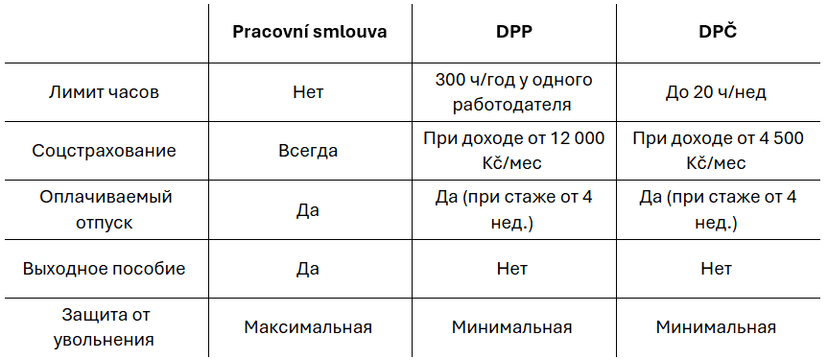
It is the pracovní smlouva that provides the maximum set of rights: paid vacation, health and social insurance, severance pay upon termination at the employer's initiative, and protection against arbitrary dismissal.
DPP — Dohoda o provedení práce (Agreement on Work Performance)
This is a flexible format for short-term or one-off employment. You can work a maximum of 300 hours per year for one employer under a DPP — this limit is counted per calendar year, and if you have several DPPs with the same employer, the hours are added up.
In 2026, the limit for monthly income under a DPP, at which insurance contributions are not required, is 12,000 CZK. If the income exceeds this threshold, contributions are calculated as with a regular employment contract.
DPČ — Dohoda o pracovní činnosti (Agreement on Work Activity)
This is suitable for more regular employment within a limited scope. There is no annual hour limit for DPČ, but the work must not, on average, exceed half of the standard working week — that is, usually no more than 20 hours per week. Insurance contributions are calculated for income from 4,500 CZK per month.
Important: To obtain a work permit or a blue card, you need a pracovní smlouva or DPČ with a salary not lower than the minimum and a working week of at least 15 hours. DPP is generally not suitable for these purposes.
Mandatory Elements of the Contract
The law strictly defines what must be included in an employment contract. If at least one of the three key elements is missing, the contract is legally incomplete. Here is what must be specified:
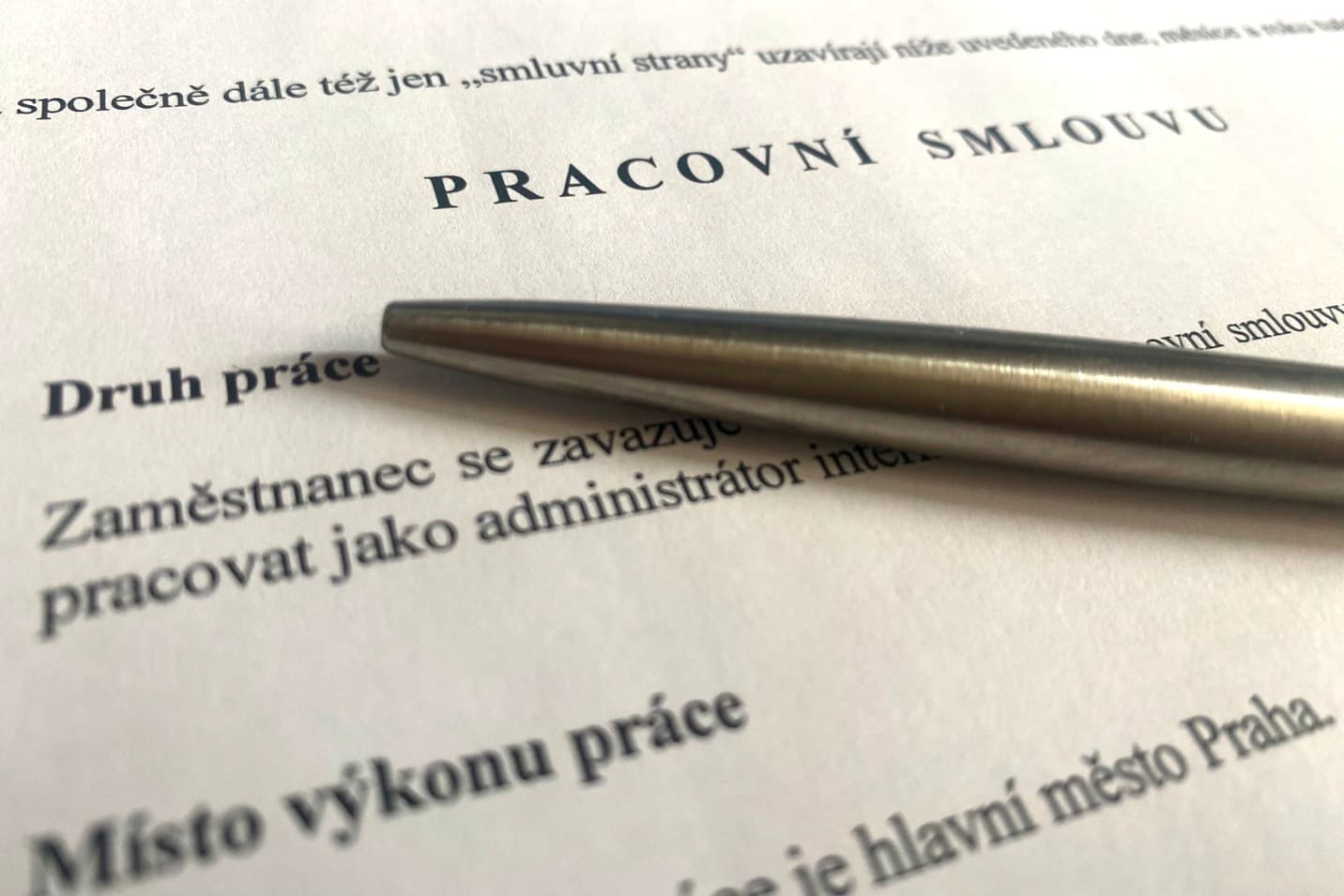
Type of work (druh práce) — a specific description of what you will be doing. Vague formulations like "performing tasks as instructed by management" are a bad sign; the employer can demand anything.
Place of work (místo výkonu práce) — a specific address or at least a municipality. If the place is not specified or is specified too broadly, the employer can transfer you anywhere without your consent.
Start date of work (den nástupu do práce) — the exact date of the first working day. All rights and obligations, including the probationary period, are counted from this date.
The contract must be concluded in writing and in two copies — one for each party. An oral agreement is not recognized by law.
What to Check Before Signing
Salary
The contract must specify the hrubá mzda — gross salary (before taxes and contributions). From January 1, 2026, the minimum wage in the Czech Republic is 22,400 CZK per month or 134.40 CZK per hour for a 40-hour work week. After taxes and contributions (netto), an employee without children receives about 19,000 CZK per month at the minimum wage.
Check: when the salary is paid (date), by what method (bank transfer or cash), and whether there are allowances for overtime, night shifts, and work on weekends and holidays. Overtime pay, holiday pay, night shift pay, and weekend pay are not included in the minimum wage — they are paid in addition to it.
Probationary Period
The probationary period (zkušební doba) for regular employees can be up to 4 months, and for managerial employees — up to 8 months. Important: the probationary period does not arise automatically — it must be clearly stated in the contract. If it is not in the contract, it is considered that you are working without a probationary period.
It is possible to shorten or cancel the probationary period by agreement, but it cannot be extended or backdated. During the probationary period, either party can terminate the contract without giving a reason.
Working Hours
The standard working week in the Czech Republic is 40 hours. Check how many hours per week your contract specifies, how shifts are distributed, whether remote work is possible, and how overtime is paid.
Vacation
By law, every employee is entitled to at least 4 weeks of paid vacation per year. Many employers offer 5 weeks — clarify this point. Vacation is accrued proportionally to the time worked.
Contract Duration
Make sure whether your contract is for an indefinite period or for a fixed term. If it is for a fixed term, clarify the end date and the conditions for extension. Remember that the law limits the number of extensions for fixed-term contracts; the employer cannot repeatedly renew it without limits.
Non-Compete Clause (konkurenční doložka)
This is a condition under which, after termination, you undertake not to work for competitors. It is legal, but the employer is obliged to pay you compensation for the duration of the restriction — at least half of your average earnings per month. If compensation is not specified, the clause is invalid.
Contract Language
The law does not require the employer to provide the contract in a language other than Czech. However, you have the right to request a translation or clarification. Signing a contract that you do not understand is strongly discouraged — use the help of a translator or legal advice if necessary.

Employee Rights
The Czech Labor Code makes no distinction between citizens and foreigners with valid work permits: all enjoy the same protection. This means equal pay for equal work, equal access to sick leave, vacation, and social benefits.
From the perspective of labor law in the Czech Republic, there are three categories of foreigners: holders of permanent residence permits (PMP), citizens of EU countries, and citizens of third countries with appropriate permits. Citizens of the EU, Norway, Iceland, Liechtenstein, and Switzerland have the right to work in the Czech Republic without special permits — under the same conditions as citizens of the country. Citizens of third countries generally need a work permit (pracovní karta) or a blue card (modrá karta) for highly qualified specialists to work.
If you are a work permit holder and lose your job, it can affect your residence status in the country. If you do not have a permanent residence permit, losing your job may mean losing the basis for your stay in the Czech Republic. Therefore, act in advance and thoughtfully when changing jobs.
Also, every employee has the right to mandatory health and social insurance — the employer deducts contributions on your behalf. Make sure the contract provides for official registration and not for salary payment "in an envelope."
Employee Obligations
An employment contract is a two-sided document. The employer has the right to demand that you adhere to the work regulations, perform your job duties according to the contract, handle company property with care, and maintain commercial confidentiality.
For intentionally caused damage, the employee bears material liability — usually up to four times the average monthly earnings (except in cases of intent or intoxication, where liability can be full). If the contract includes an agreement on material liability (dohoda o odpovědnosti za svěřené hodnoty) — read its terms carefully.
Termination of Contract
An employment contract can be terminated in several ways:
By mutual agreement (dohodou) — the simplest way, where the parties agree on the terms of separation in writing. There are no mandatory notice periods.
At the employee's initiative (výpověď zaměstnance) — the employee has the right to resign at any time by notifying the employer. No severance pay is due in this case.
At the employer's initiative (výpověď zaměstnavatele) — the employer must state a specific legal reason for termination. Unjustified dismissal is illegal.
From June 1, 2025, the standard notice period is at least 2 months. An important change: this period now starts from the date of receipt of the notice of termination, not from the first day of the following month, as it was before. If the dismissal is due to a breach of labor discipline, the notice period may be shortened to 1 month.
Severance Pay
Severance pay is paid upon termination at the employer's initiative for organizational reasons (staff reduction, position elimination, company relocation). Its amount depends on the length of service:
less than 1 year — 1 average monthly earnings,
from 1 to 2 years — 2 average monthly earnings,
over 2 years — 3 average monthly earnings.
Severance pay is not paid upon resignation or dismissal for misconduct.
If Dismissal is Illegal
If you believe you have been dismissed illegally, you have the right to challenge it in court within 2 months from the end of the employment contract. Until the court makes a decision, you are entitled to compensation equal to your average earnings.
Where to Seek Help
If you encounter difficulties with your employer or have questions about your contract, here is where you can turn:
Státní úřad inspekce práce (SÚIP) — The State Labour Inspection Office checks if labor laws are followed. If your employer breaks your rights, you can make a complaint online or in person. Website: suip.cz.
Úřad práce ČR — The Labour Office gives advice about jobs and workers' rights. Information for foreign workers is available in several languages. Website: uradprace.cz.
Integrační centrum Praha (ICP) and similar regional integration centers offer free legal advice for migrants, including in Russian.
Trade unions (odbory) — if there is a trade union at your company, its representatives must protect the interests of all workers, including foreigners.

Your employment contract defines your status in the Czech Republic for the whole time you work. Before you sign, make sure you understand every point: the type of contract, salary amount, working hours, trial period, and conditions for ending the contract. Do not be afraid to ask your employer questions, ask for time to read it, and seek legal help if needed. Czech law is on your side — the main thing is to know your rights.