
Imagine: you went to your home country for a few months, but in the Czech Republic, you need to extend your rental agreement, receive an important letter, or submit documents to the OAMP (Office for Alien Affairs). Or the opposite: you live in the Czech Republic, but your apartment is back home, and you need to sell it, but you cannot come in person. In both cases, there is one solution — a power of attorney. For a migrant, this is one of the most useful legal tools: it allows you to act through an authorized person where your physical presence is impossible or undesirable. Let's look at how this works in the Czech legal system — in detail, honestly, and without unnecessary legal fog.
What is a Power of Attorney under Czech Law
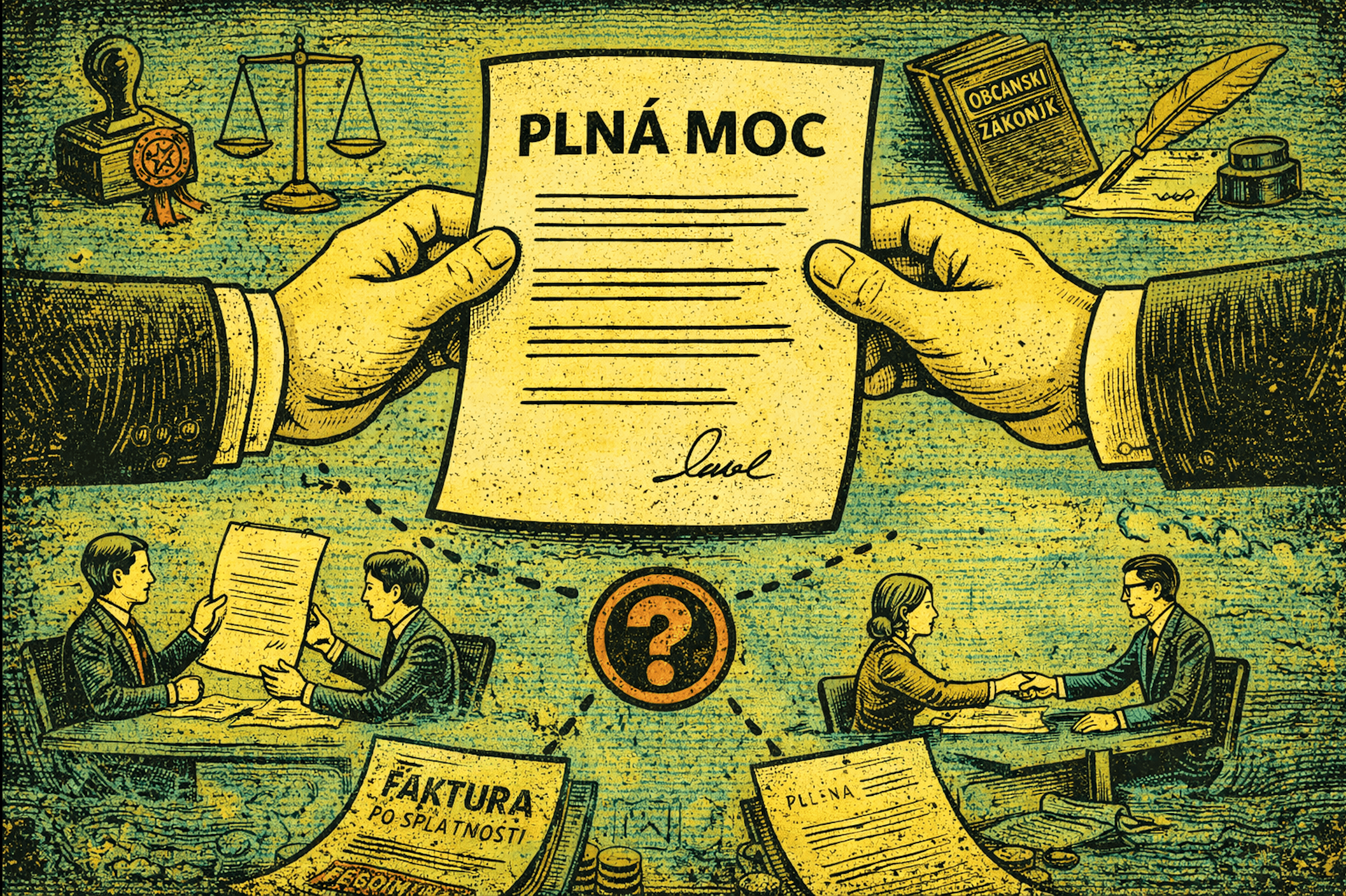
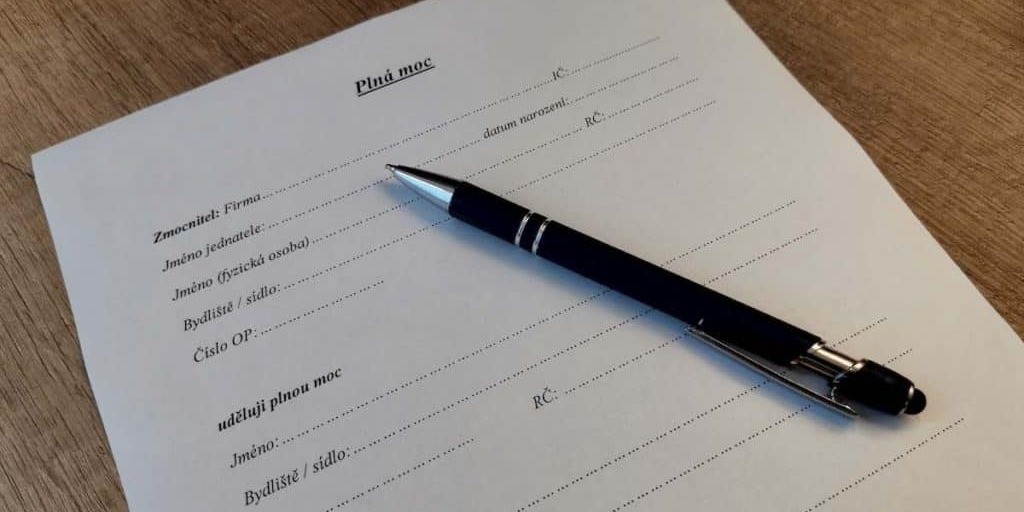
In Czech, a power of attorney is called plná moc. It is a document by which one person (zmocnitel — the principal) grants another person (zmocněnec — the agent) the authority to perform legally significant actions in their name.
The legal basis is Act No. 89/2012 Coll., the Civil Code of the Czech Republic, paragraphs 436 and onwards. It states that rights and obligations arising from the agent's actions directly apply to the principal — meaning, if your representative signs something within the scope of the power of attorney, it is binding for you.
A power of attorney is a unilateral legal act. This means that only the principal drafts the text, and the agent is not required to be present during its drafting or to sign the document.
Do not confuse plná moc with similar concepts. Pověření is an internal authorization for an employee of a company to act on its behalf, and unlike a power of attorney, it does not require signature verification. With pověření, a legal entity acts through its authorized employee; it is not the representation of a party to a proceeding by another person, but the action of the party itself through its employee.
Both principals and agents can be natural or legal persons. If a power of attorney is issued to a legal entity, its statutory bodies act on its behalf. Furthermore, a power of attorney can be issued to multiple agents simultaneously.
Types of Powers of Attorney
Czech law distinguishes between two main types of powers of attorney, and understanding the difference between them is extremely important.
Special Power of Attorney (speciální plná moc) — the most common option. It grants the agent authority for a specific act or action. If the agent acts beyond the scope of the power of attorney without the principal's knowledge, they are acting only in their own name. This is a safer option because it clearly limits what your representative can do.
General Power of Attorney (generální plná moc) — grants authority for a wide range of actions. This is a power of attorney issued for an unlimited number of future proceedings on a specific subject. It requires increased attention: such a document should only be issued to an absolutely trustworthy person, as it effectively places them in your position on a significant number of matters. For a general power of attorney in administrative matters, notarization of the signature is mandatory.
One-time Power of Attorney — a private case of a special power of attorney, issued for one specific action (e.g., to receive one package or sign one specific contract). After this action is completed, the document loses its validity.
A substitution power of attorney (substituční plná moc) should also be mentioned separately. The agent can authorize another person in their place. This possibility must be explicitly stated in the original power of attorney.
When a Migrant Needs a Power of Attorney
This is where plná moc reveals its full practical value. Here are the most common situations for foreigners in the Czech Republic.
Representation in State Authorities
One of the most frequent reasons. If you cannot personally attend an appointment at the OAMP (Office for Alien Affairs of the Ministry of the Interior of the Czech Republic) to submit documents, extend your card, or for other actions — your representative can do it for you.
A general power of attorney, especially one from a lawyer, can be accepted as a power of attorney for proceedings on an application for a residence permit (only for that specific proceeding), if it includes authorization for representation in administrative proceedings — without the requirement of official signature verification. This is an important practical concession: a notary is not required for representation in one specific case.
However, if your employer or someone else offers you a power of attorney to sign, you are not obligated to do so. You have the right to independently and free of charge resolve all matters related to your residence. Do not sign anything you do not understand.
Real Estate Transactions
Are you abroad and need to buy or sell an apartment in the Czech Republic? If you know in advance that you cannot be present when signing the contract documents, the simplest option is to use a correctly drafted power of attorney.
A power of attorney for real estate transactions must be detailed: it can include authorization to sign an agreement with a real estate agency, sign a purchase agreement, receive payment, receive correspondence, and much more. By adding restrictions to the power of attorney — for example, prohibiting the sale of real estate below a certain price or to a specific buyer — you can significantly reduce risks.
Vehicle Registration and Transfer
If you want to transfer ownership of a vehicle but cannot appear in person, a power of attorney is the standard solution. Key requirement in 2026: the principal's signature must be officially verified, otherwise the document is invalid. Verification can be done at Czech POINT, at the post office, or at a notary. Please note that from 2026, a digital power of attorney for vehicle transfer has been introduced — if both parties have electronic identification (e.g., Bankovní identita), a power of attorney can be issued through the Transport Portal without printing and verification.
Receiving Documents, Mail, and Packages
A power of attorney allows you to authorize another person to receive important correspondence, a package, or an official document. For postal items, in many cases, an oral or simple written power of attorney is sufficient, but for official papers from state authorities, a written document is better.
Tax, Financial, and Social Matters
In matters with the Czech Social Security Administration (ČSSZ) or the Labor Office, you can authorize another person for most routine actions: submitting reports, using the ePortál ČSSZ electronic services, submitting other forms. Important note: the authorization does not extend to administrative proceedings that conclude with a decision: applications for benefits, appeals, and similar matters require personal participation or a special power of attorney.
Representation in Court
For court cases, a power of attorney is a standard tool. Most often, a lawyer acts as the agent. In this case, a written power of attorney with the principal's signature is usually sufficient; notarization is generally not required unless specified otherwise for a particular case.
Where and How to Obtain a Power of Attorney
Simple Written Form
For many everyday tasks, a power of attorney drafted by yourself and signed by the principal is sufficient. An officially verified signature of the principal is not a mandatory condition for the validity of the power of attorney — the obligation to verify arises either directly from the law or from the conditions of a specific official action where this obligation must be explicitly stated.
Signature Verification — Czech POINT and Post Office
If verification is needed, the most accessible method is Czech POINT. These are public service points located at post offices, municipal offices, and some banks. At the post office or Czech POINT, verifying one signature costs 30 CZK.
The power of attorney is drafted at home, but it must be signed in the presence of a notary or a Czech POINT employee — directly on site. The current date is also placed there.
Notary
A notary (notář) is the most reliable option, especially for serious transactions. When verifying a signature, the notary confirms that the natural person signed the document in person before them or acknowledged a signature already on the document as their own.
However, the notary is not responsible for the content of the document, either legally or factually. The document must be fully completed at the time of verification — it is not possible, for example, to verify a signature on a blank sheet of paper.
The notary's fee for verifying one signature is 70 CZK excluding VAT. Additional costs may be incurred. You can find a notary through the registry on the website of the Chamber of Notaries of the Czech Republic (nkcr.cz).
Lawyers also have the right to verify signatures — this is stipulated in the Attorneys Act. Signatures can be verified by notaries, lawyers, captains of Czech ships, as well as Czech consular and diplomatic missions abroad.
If the Power of Attorney is Needed for Actions Abroad
If your document will be used in another country, an additional step is required — an apostille or superlegalization. If the document is intended for use abroad, the certifying inscription must be signed by a notary or their permanent deputy. You must inform the notary's staff about your intention to use the document abroad.
How to Correctly Draft a Power of Attorney
Regardless of the form, any power of attorney must contain the following:
Principal's details (zmocnitel): name, surname, date of birth, residential address. For foreigners — also passport number or residence permit number.
Agent's details (zmocněnec): the same information.
Precise description of the authority: what exactly the agent is authorized to do. The more specific, the better. Vague wording can lead to refusal of recognition or abuse.
Date of drafting the power of attorney.
Principal's signature. The agent's signature is not mandatory.
Validity period (recommended). If not specified, the power of attorney is valid indefinitely until revoked.
Sample Wording
A simple special power of attorney might look like this:
PLNÁ MOC
Já, [Name Surname], datum narození [date], trvale bytem [address], číslo pasu/povolení k pobytu [number],
tímto zmocňuji
[Agent's Name Surname], datum narození [date], trvale bytem [address],
k [precise description of the action — for example: zastupování ve správním řízení před OAMP MV ČR ve věci prodloužení zaměstnanecké karty / podpis smlouvy o pronájmu bytu na adrese ... / převzetí zásilky č. ... na České poště].
Tato plná moc platí do [date] / na dobu neurčitou.
V [city], dne [date]
[Principal's signature]
Vague authority is one of the most common problems. The phrase "represent my interests" without specifics may be rejected by an institution.
Incorrect date — if the date is missing or entered incorrectly, the document may be considered invalid.
Using someone else's template without adaptation — a universal template taken from the internet may not meet the requirements of a specific authority. This is especially true for OAMP, courts, and notarial transactions.
Power of Attorney from Abroad
One of the most relevant scenarios for migrants: you are in your home country, and a legally significant action needs to be taken in the Czech Republic.
If you are abroad, you can personally contact a diplomatic mission of the Czech Republic (embassy or general consulate) to verify your signature on the document. For use in the Czech Republic, you either sign the document before a consular officer or bring it already signed and acknowledge the signature as your own.
Because personal presence is required for identity verification, notarization by mail is not possible. A fee of 250 CZK is charged for each notarized signature.
After notarization at the consulate, you can send the power of attorney to the Czech Republic by mail.
Another option is to go to a local notary, have your signature notarized there, and then get an Apostille. More about Apostille below.
Ukrainian Power of Attorney for Use in the Czech Republic
Here is good news: documents from Ukraine are recognized in the Czech Republic without additional Apostille – this is established by international agreements and works in practice.
This means that a power of attorney issued by a Ukrainian notary is, in principle, valid in the Czech Republic. However, the Czech authority or institution will likely require a translation into Czech performed by a sworn translator (soudní tlumočník). A list of official sworn translators in the Czech Republic is published on the website of the Ministry of Justice of the Czech Republic (justice.cz).
Czech Power of Attorney for Use in Ukraine
Formally, an Apostille is not required, as an agreement on mutual recognition of official documents has been signed between the countries. However, in practice, in 2025–2026, Ukrainian local authorities often still require an Apostille.
Experts strongly recommend still getting an Apostille on powers of attorney from the Czech Republic – especially when it comes to property matters. If an Apostille is required at the place of use, it is very difficult to argue against it, and returning the document to the Czech Republic for Apostille is much more unpleasant than doing it right away.
Notaries in the Czech Republic can draft and notarize documents in foreign languages – including Ukrainian and Russian. In this case, the power of attorney can be prepared directly in the language of the country where it will be used.
The Apostille on notarial documents is issued by the Ministry of Foreign Affairs of the Czech Republic in Prague. Before that, the document is usually certified at the city magistrate.
Revocation and Termination of Power of Attorney
Revocation by the Principal – The principal has the right to revoke the power of attorney at any time. If the principal revokes the power of attorney, the authority ceases. However, the agent must be informed about it. If the agent did not know about the revocation, the revocation will not be effective: the agent's actions will continue to bind the principal as if the power of attorney were still in effect.
This means that if you want to revoke a power of attorney, it is not enough to simply write a paper – the agent and, if necessary, the relevant authority must be officially notified.
Refusal by the Agent – The agent can refuse their authority.
Expiration of Term – If an expiration date is specified in the document, the power of attorney automatically terminates after that date.
Death of Either Party – The power of attorney terminates upon the death of either the principal or the agent.
Completion of Action – A one-time power of attorney terminates after the action for which it was issued has been performed.
If you wish to revoke a power of attorney submitted to OAMP, the revocation must have the same requirements as the power of attorney itself: if the signature was officially certified when submitted, the same requirement applies to its revocation.
Practical Advice and Common Mistakes
Clarify requirements in advance. Before drafting the document, call or write to the authority where the power of attorney will be submitted and clarify their specific requirements. Some institutions (banks, insurance companies, Czech Post) have their own power of attorney forms – it is easier to use them than to redo them later. A number of organizations have their own pre-prepared power of attorney forms that satisfy all parties.
Do not sign what you do not understand. This is especially true for foreigners, who are sometimes offered a broad power of attorney by employers or intermediaries under the guise of "help with documents." You are not obligated to give anyone a power of attorney to handle your migration matters – all of this can be done yourself and for free.
A sworn translator is not an option, but a necessity. If the power of attorney is drafted in Ukrainian, Russian, or another language and will be submitted to a Czech authority, you will need a translation performed by a soudní tlumočník. Czech authorities will not accept a simple translation by a friend or colleague.
Check the validity period. If no period is specified, the power of attorney is indefinite – which is convenient but carries risks. It is recommended to set a specific period, especially for broad powers.
Get an Apostille to be safe. If the power of attorney will be used abroad – get an Apostille, even if it is not formally required. It is cheaper and easier than returning the document later for revision.
Keep a copy. Always keep a certified copy of the issued power of attorney for yourself.

A power of attorney is not a bureaucratic formality, but a real tool that saves time and nerves. The main thing is to issue it consciously, clearly define the powers, and trust only verified people. The Czech system in this regard is quite transparent and predictable: once you understand it, you will be able to confidently use this tool in a wide variety of life situations.