
This section is under construction — the data may be inaccurate
Transport in Czechia for foreigners
Not everyone needs to exchange their license — there's an exception for residence permits up to 1 year. An annual Prague public transport pass costs about 10 Kč per day, and refusing a breathalyzer test is punished more severely than drunk driving itself. Prices, deadlines, and fines 2026 — checked by KOMPAS editorial team from official sources.
Articles about Transport in Czechia

City guides
What is where, where to go with your paperwork, what housing costs and how the transport works — city by city.
Driver and Passenger Dictionary
Czech transport terms in simple words — with translation and a short explanation
Transport News
Fares, rules, fines, and schedules — short and to the point
Tram and bus head-on collision in Prague blocked Chodovská street
Repair of the main bridge in Pardubice is moving into the final stage
Prague transport has prepared for summer and introduced new warehouse markings
Prague and Brno record a high number of parking fines
About the essentials
Do you need to exchange your Ukrainian driver's license for a Czech one — and who doesn't need to do it at all?
Start not with the procedure, but with an exception that is rarely mentioned: if your stay in the Czech Republic is not permitted for a period longer than 1 year, the obligation to exchange your license does NOT apply. For some holders of temporary protection, this completely resolves the issue — there is nothing to exchange.
If the exception does not apply to you, the obligation is triggered by obvyklé bydliště (usual residence) — meaning staying in the Czech Republic for 185 days in a calendar year. From the moment it arises (or when you receive a long-term residence permit), you have 3 months to exchange it. The procedure is based on Ukraine being a party to the Vienna Convention of 1968, and the license must comply with it.
You can apply at any obecní úřad obce s rozšířenou působností (municipal office with extended powers) — there are 206 such offices in the Czech Republic, and there is no link to your specific city. You do not need to bring a photo; it will be taken on site.
We are deliberately not providing a specific fee for the exchange here: official and secondary sources give different figures, and making a mistake here costs you money. Check the current price and the full list of documents and deadlines directly on site or on the website of the Ministry of Transport.
How long can you drive on Ukrainian license plates and what about car registration?
A car with Ukrainian registration can be operated in the Czech Republic for up to 6 months without re-registration. This is a separate period; do not confuse it with the three-month period for exchanging your license.
When it comes to registration, the main thing is the deadline: you have 10 working days for re-registration, and the fine for exceeding it can reach 50,000 CZK. This is the most expensive mistake in the entire section, and it arises simply from ignorance.
The administrative fee for registration is 800 CZK, but through the Portál dopravy (Transport Portal) online — it's 640 CZK, which is 20% cheaper. Add the evidenční kontrola (emission control, about 400 CZK) and the license plate (500 CZK).
Next, the car has three regular expenses: STK (technical inspection; first after 4 years, then every 2 years; 2,000–2,700 CZK including emissions — prices are not regulated by the state and vary between stations), povinné ručení (mandatory liability insurance; typically 1,700–5,000 CZK per year, average 4,612 CZK, median 4,157 CZK; Prague is the most expensive — around 6,000 CZK, Pardubice Region and Vysočina — around 3,800 CZK, expected price increase ~5%), and the dálniční známka (highway vignette).
How much does public transport cost in Prague in 2026 and what is more advantageous — tickets or a pass?
From 01.01.2026, for the first time, there is a difference between paper and electronic tickets in Prague. 30 minutes: 36 CZK in the app versus 39 CZK on paper. 90 minutes: 46 CZK versus 50 CZK. Reduced fares — 18/19 CZK and 23/25 CZK respectively. This means paper is now more expensive by default.
However, passes have not increased in price at all: monthly — 550 CZK, quarterly — 1,480 CZK, annual — 3,650 CZK. The annual pass comes out to about 10 CZK per day and remains the most advantageous option by far: it pays for itself after just three trips per week. Reduced fare passes — 130 / 360 / 1,280 CZK. The current price list is on the DPP website.
Discounts: children under 6 travel for free; 6–15 years — 50% without a document; 60–65 — 50%; 65+ — significantly reduced; students 18–26 — 50% with ISIC. In Ostrava, an annual pass costs 4,400 CZK in the e-shop (4,450 CZK at the ticket office), and seniors 65+ in the Ostrava zone travel for free.
Between cities — trains. ČD offers the IN Karta (options IN 25 / IN 50 / IN 100, valid from 14.12.2025), and from January 2026, a new group discount ČD DNY has been introduced. LeoExpress offers 25% for Junior/Student/Senior in Economy; RegioJet also operates on the same routes with its discount system — check the conditions with the carrier.
How much does the dálniční známka (highway vignette) cost in 2026 and where to buy it?
The annual vignette for 2026 costs 2,570 CZK — this is 130 CZK more than in 2025. Shorter options: 30 days — 480 CZK, 10 days — 300 CZK, 1 day — 230 CZK.
Fuel prices change radically. CNG/LNG: annual — 1,280 CZK, 30 days — 240 CZK, 10 days — 150 CZK, 1 day — 110 CZK. Plug-in hybrid: 640 / 120 / 70 / 50 CZK. And electric cars and hydrogen cars pay 0 CZK — the vignette is free for them for any duration. But if the car is registered abroad, you need to submit an oznámení o osvobození (notification of exemption) to get the exemption; otherwise, the benefit will not apply automatically.
The vignette is electronic and linked to the license plate number (RZ) — you don't need to stick anything on the windshield, and you are checked by cameras.
The only official website is edalnice.gov.cz. The domain is exactly like this; there are traditionally many duplicate websites around the topic of vignettes that sell the same thing at a higher price or simply collect data. Buy only on the official domain.
How do fines and points for violations work in the Czech Republic?
The rules are set by Act No. 361/2000 Coll., and a new amendment from 01.01.2024 simplified the point system from five categories to three: 2, 4, or 6 points per violation. Fines range from 1,500 to 75,000 CZK.
At 12 points, your license is revoked, and you must surrender it within 5 days. Points are deducted slowly: 12 months without violations means minus 4 points; another 24 months means minus 4 more; after 36 months, all remaining points are removed.
The "Dvakrát a dost" (Twice and you're out) rule works separately: two six-point violations in 3 years mean you automatically lose your driving privileges (up to 3 years), regardless of your total points. A similar "Třikrát a dost" (Thrice and you're out) rule applies for three medium violations in 2 years.
For speeding in the city: +10–19 km/h means 1,500–2,000 CZK and 2 points; +20–39 km/h means 2,500–3,500 CZK on the spot and 4 points; +40 km/h or more means 7,000–25,000 CZK, a driving ban, and immediately 6 points. Outside the city: up to +29 km/h means 1,500–2,000 CZK and 2 points; +50 km/h or more means 7,000–25,000 CZK and 6 points, which is handled only through administrative proceedings and not settled on the spot.
Drunk driving - what are the penalties and why shouldn't you refuse a test?
Czechia has zero tolerance: any detected amount of alcohol is punished; there is no legal limit for "one beer".
Up to 0.3‰ means a fine of 7,000–25,000 CZK and a driving ban for 6–18 months. From 0.3 to 1.0‰ means the same fine of 7,000–25,000 CZK, plus 6 points and a ban for 6–18 months. Over 1.0‰ is no longer an administrative offense but a criminal offense under § 274 of the Criminal Code.
And the most costly thing for people here is that refusing the test is punished more severely than the actual offense of 0.3–1.0‰. Refusal results in a fine of 25,000–75,000 CZK, a driving ban from 18 months to 3 years, and 6 points. Compare this: for actual 0.3–1.0‰, the fine is a maximum of 25,000 CZK and a ban up to 18 months.
The logic is simple: by refusing "just in case," you are guaranteed to get the upper penalty limit instead of the lower one. If you are stopped, take the test.
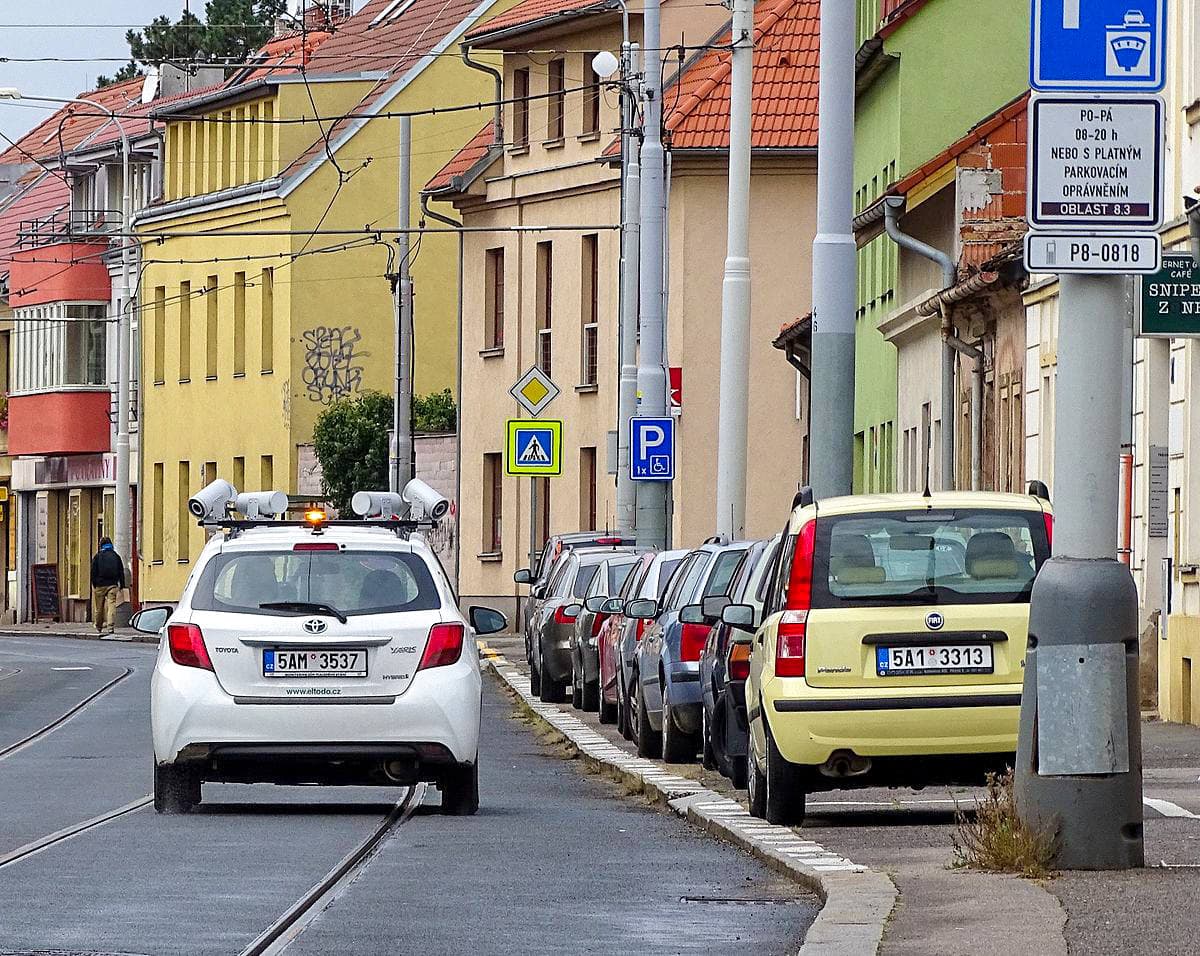
Parking in Prague - can I get a resident permit with a temporary stay (přechodný pobyt)?
Yes — and this is little-known and practically useful. The standard requirement for a resident parking permit is a permanent residence (Trvalý pobyt) in that part of the city, but temporary residence (přechodný pobyt) also qualifies for foreigners. Many do not even apply, believing that without permanent residence, there are no chances.
The price increases sharply with each car: the first car costs about 1,200 CZK per year, the second costs 7,000 CZK, and the third and subsequent cars cost 24,000–36,000 CZK. This means one car per family is symbolic, while a second car is already a significant cost.
Zones: blue — for residents and permit holders, visitors can park for a maximum of 3 hours for 40–80 CZK/hour; purple — for both residents and visitors, 20–60 CZK/hour; orange — only for visitors, long-term permits do not apply there, the rate is indicated by the sign. Outside working hours, parking zones are free — check the sign at the entrance.
Two important changes and risks. From 01.01.2026, free parking for low-emission cars (EL badges) has ended — everyone pays, and emission-free cars get a 50% discount. For parking in a blue zone without a permit, you will be charged 500–1,500 CZK on the spot or 2,000–4,000 CZK through administrative proceedings; no points are awarded for this, but towing in Prague costs about 4,000 CZK plus 200–400 CZK for each day of storage. Zone conditions are available at parking.praha.eu.
Questions about driver's licenses, cars, or public transport? Ask the community
Exchange of driver's licenses, DPP coupons, vignettes, technical inspections (STK), and Prague parking zones — experience and advice from the Ukrainian community daily on our Telegram channel
Subscribe