
If you live in the Czech Republic and are thinking about self-employment or freelancing, sooner or later you will encounter the abbreviation OSVČ — osoba samostatně výdělečně činná, which literally translates to "person independently carrying out gainful activity." This is the Czech equivalent of the Ukrainian FOP (sole trader) or Russian sole trader (individual entrepreneur): an individual entrepreneur without forming a legal entity.
What is OSVČ and why it's important to know
The main difference from FOP (sole trader) or sole trader lies in the details: a different tax system, different contributions, and different rules. Understanding them from the beginning means avoiding unpleasant surprises.
OSVČ is popular among migrants for several reasons. Firstly, it is relatively simple to register, allows you to work legally for several clients at once, offers flexibility in organizing your working hours, and potentially higher income compared to employment.
Most often, people work through OSVČ in IT, construction, marketing, beauty, and freelance sectors. Often, employers themselves suggest employees re-register as OSVČ — this is beneficial for them as it removes obligations under an employment contract.
Who among newcomers can open an OSVČ
Ukrainians with temporary protection
Citizens of Ukraine with temporary protection (dočasná ochrana) have the right to open an OSVČ in the Czech Republic. They do not need a separate business license — the temporary protection status already grants this right.
Other foreigners
Citizens of countries outside the EU generally need a valid residence permit with permission for entrepreneurial activity to open an OSVČ. A student visa is usually not suitable for registering OSVČ as a primary activity — check with the trade licensing office for your specific situation.
You can combine OSVČ with employment under a contract. Many people combine paid employment and OSVČ — for example, they work in an office and take on freelance orders in parallel. In this case, contributions are partially covered by the employer, and OSVČ can be a "secondary" activity with simplified conditions.
Documents you will need
Passport and proof of legal stay (visa, residence permit, or confirmation of temporary protection).
Proof of residential address in the Czech Republic.
In some cases, proof of professional qualification.
1,000 CZK to pay the registration fee.
A criminal record certificate and the property owner's consent for the address to be used for business (souhlas s místem podnikání) may or may not be required depending on the specific trade licensing office — check in advance.
How to open an OSVČ: step-by-step guide
The registration process takes an average of 1–5 working days and proceeds as follows:
Step 1. Trade Licensing Office (živnostenský úřad)
This is where you obtain a živnostenské oprávnění — a business license. The office is located at most municipal offices. You will fill out an application on-site — they will also help you understand the type of activity.
It is important to choose the correct type of trade. Most types of activities (IT, marketing, freelance, translation, consulting) fall under the category of volná živnost — a free license that does not require qualification proof.
Step 2. Obtaining an IČO
After submitting the documents, you will be assigned an IČO — an entrepreneur identification number. It is used in all contracts and invoices.
Step 3. Registration with the Tax Office (Finanční úřad)
If you tick the appropriate box on the application at the živnostenský úřad, registration with the tax office will happen automatically. Otherwise, you need to contact them yourself.
Step 4. Registration with Social Security (ČSSZ)
Similarly, if you tick the box on the application, it happens automatically. The authority is Česká správa sociálního zabezpečení (ČSSZ).
Step 5. Health Insurance Registration
You choose an insurance company (e.g., VZP or another). This can also be done through a single application.
Step 6. Opening a datová schránka
After receiving the výpis z živnostenského rejstříku (extract from the trade register), you need to open a digital mailbox (datová schránka) at the post office. This is the official communication channel with government authorities.
Step 7. Online Registration
Part of the process can be completed through the portal businessinfo.cz or through intermediaries. The latter is convenient if you don't speak Czech, but the services cost money — from a few thousand CZK.
Registration cost: 1,000 CZK (state fee for the first type of activity).
How much does OSVČ cost per month
Even if you have no income, you still have to pay mandatory contributions.
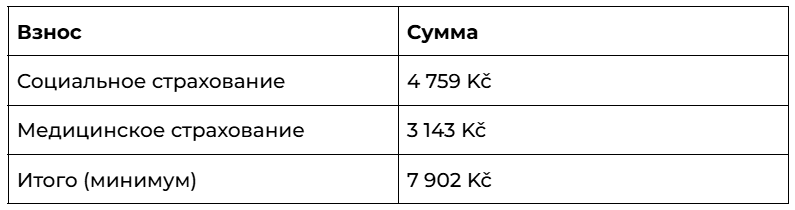
The amounts are approximate; as income increases, contributions are recalculated and increase.
Additional expenses
Accountant — from 500 to 2,000+ CZK per month (optional, but highly recommended).
Bank services — many OSVČ use a regular account, but a business account is more convenient.
VAT (DPH) — if annual turnover exceeds 2,000,000 CZK, you must register as a VAT payer.
Income tax — paid once a year based on the tax return.
What taxes does OSVČ pay
Income Tax
The basic rate is 15% of the taxable base. For income above a certain threshold (approximately 36 times the average annual salary), a higher rate of 23% applies.
When calculating the taxable base, OSVČ can use lump-sum expenses (paušální výdaje) instead of actual expenses. For most types of activities, this is 60% of income; for some, it is 80%. This significantly reduces the tax burden. It means that actual expenses do not need to be documented, and the deduction is substantial.
Lump-sum Tax (paušální daň)
This is a special regime where the entrepreneur pays one fixed amount per month, covering tax, social, and health insurance. In 2026, for the first tier (1. pásmo), this will be 9,984 CZK per month.
Who is the lump-sum tax suitable for:
Annual income does not exceed 2,000,000 CZK.
No employees.
Not a VAT payer.
No other types of taxable income (investments, rent, etc.).
The main advantage is not having to file a tax return or keep strict records. This is very convenient for freelancers with predictable income.
Pros and cons of working through OSVČ
Financial advantages. With proper planning, OSVČ allows you to pay less tax than in paid employment with similar income — due to lump-sum expenses and other deductions.
Flexibility. You set your own schedule, work with multiple clients simultaneously, and can serve foreign companies. This is especially relevant for IT specialists and freelancers.
Ease of entry. Registration takes a few days, and there is significantly less bureaucracy than when opening an s.r.o. (equivalent to an LLC).
International work. OSVČ can issue invoices to clients from any country — this is standard practice for developers, designers, and consultants.
Mandatory contributions without guaranteed income. Approximately 7,900 CZK per month must be paid regardless of whether you earned anything or not. This is a significant burden with unstable income.
Lack of employment guarantees. There is no paid vacation, proper sick leave, or stable salary. Everything is your responsibility.
Švarc system. This is an illegal practice where an employer forces an employee to work through OSVČ instead of issuing an employment contract to save on contributions. Signs of the Švarc system include a fixed schedule, working for only one client, and a lack of real independence. Fines threaten both the employer and the entrepreneur for this. If you are offered such a scheme, it is best to consult a lawyer.
Tax return. Once a year, you must file a přiznání k dani z příjmů (income tax return). Many newcomers forget about this or do not know that it is mandatory.
Common mistakes made by newcomers
1. Opening an OSVČ without stable income. Mandatory contributions start accruing from the first month.
2. Not accounting for monthly payments. Many people only look at income tax and forget that social and health insurance are paid separately and constantly.
3. Not knowing about the tax return. A tax return must be filed annually — even if you are on the lump-sum tax (in this case, a tax return is not needed, but you had to choose this regime in time).
4. Working without accounting or an accountant. Without basic accounting of income and expenses, it is impossible to correctly fill out the tax return and calculate contributions.
5. Czech self-employed status (OSVČ) and Ukrainian sole-trader (FOP) are similar. The main idea is the same, but the rates, limits, and rules are different. Experience as a Ukrainian FOP may not always be directly useful.
Before you go to the trade licensing office (živnostenský úřad), answer these questions:
Do I have a stable income or specific clients?
Am I ready to pay about 7,900 CZK per month no matter what?
Do I need an accountant, or can I manage by myself?
Is the lump-sum tax suitable for me (income up to 2 million CZK, no VAT)?
Is my situation considered undeclared work (švarcsystém)?
What type of sole-trader licence (živnosť) do I need for my activity?