

The Czech Republic signed the 1968 Vienna Convention on Road Traffic, the same one signed by most post-Soviet countries. In practice, this means road signs look familiar, lane markings are easy to understand, and basic rules are not surprising. However, there are enough details and nuances that can be costly for a driver from another country who has not studied local laws. Since January 1, 2024, the system of fines and points has been significantly updated.
Exchanging a Driver's License
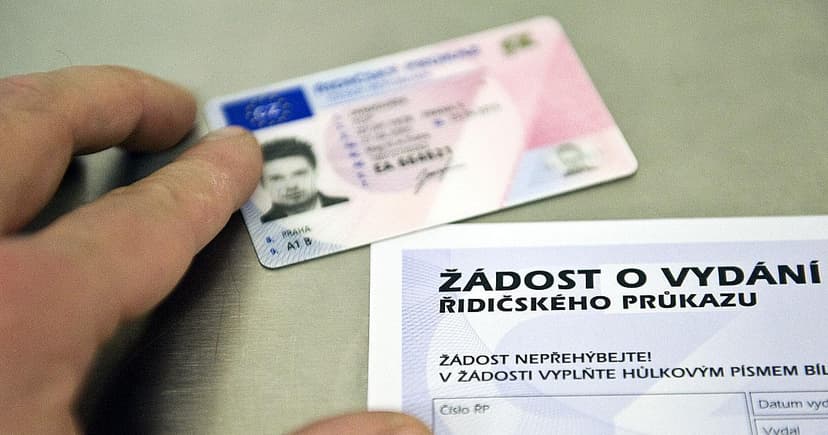
If you have moved to the Czech Republic and have a driver's license from a non-EU country, you must exchange it. A foreigner who temporarily or permanently resides in the Czech Republic for more than one year, according to the foreigner residence law, must apply for an exchange of their license within three months of receiving their residence permit.
The exchange is carried out at any municipality with extended powers (obec s rozšířenou působností, ORP) – throughout the country, regardless of your place of registration. If the driver's license was issued by a country that signed the Vienna or Geneva Convention on Road Traffic, the procedure is simplified. If not, the driver must pass an exam at a driving school and undergo a medical examination.
The exam includes a theoretical test (traffic rules and first aid) and practical driving. All exams must be passed within 12 months from the date of the first exam; otherwise, you will have to complete the full course again.
Citizens of EU countries are in a special position: holders of licenses issued by an EU country have the option, but not the obligation, to exchange them for a Czech license.
Key Road Rules
Czech traffic rules are generally standard for Europe; however, a few points are especially important to know from day one.
Speed Limits:
in built-up areas – no more than 50 km/h
outside built-up areas – no more than 90 km/h
on highways – no more than 130 km/h (80 km/h in sections within built-up areas).
Alcohol. The maximum permissible blood alcohol level is 0.0 per mille – meaning zero tolerance. There is no "up to 0.3" like in some other countries. This is one of the most common misconceptions for foreign drivers.
Headlights. At any time of day, you must drive with your low beam headlights on. Driving without headlights, even on a sunny day, is a violation.
Seat belts are mandatory for all passengers – both in the front and back seats. A child under 12 years old and shorter than 150 cm must only sit in the back seat in a special child restraint system.
Using a phone while driving is prohibited without a hands-free system. Since 2024, this violation results not only in a fine but also in points (more details below).
Vignette for highways. Toll roads in the Czech Republic are marked with special signs. To use them, an electronic vignette (elektronická dálniční známka) is required. Starting in 2025, its cost is 2,440 CZK for an annual vignette, 460 CZK for a monthly, 290 CZK for a weekly, and 210 CZK for a daily. You can get the vignette online at edalnice.cz – you will only need your country of registration, car number, and email address. Electric cars are exempt from vignette payment entirely, while gas-powered cars receive a discount. Driving on a toll road without a vignette is subject to a fine of up to 20,000 CZK.
Point System: How It Works
The Czech Republic uses a system of penalty points (trestní body) – and this is one of the most effective traffic control tools in the country. Drivers are assigned penalty points for violations, and if they accumulate more than 12 points, their license is suspended for one year. You cannot keep violating the law indefinitely by simply paying fines.
Since January 1, 2024, the system has been reformed: instead of the previous five tiers, three categories of penalty points have been introduced – 2, 4, and 6. Each recorded violation receives its "weight" depending on its severity. If multiple violations were committed simultaneously in one incident, only the most serious one is counted.
Table of Major Violations
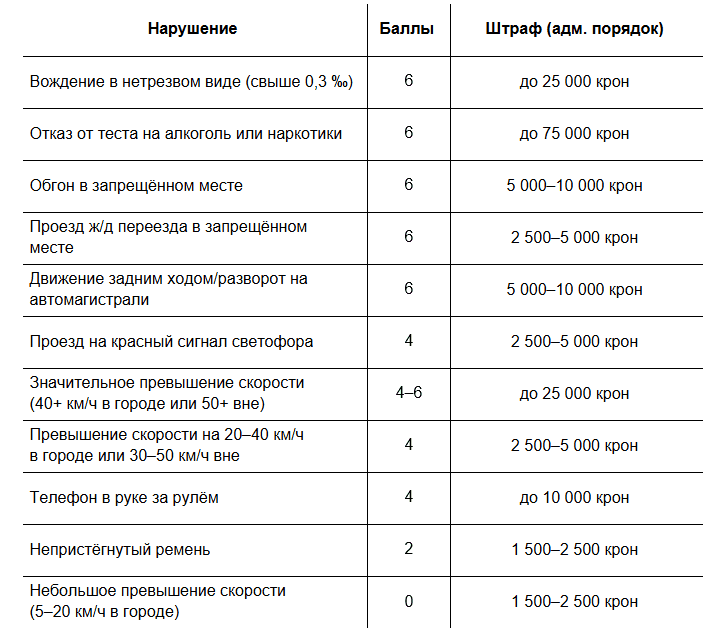
For minor violations, the on-the-spot fine is up to 3,500 CZK; for serious violations, the amount paid to the police officer on the spot has increased to 5,500 CZK. Within administrative proceedings (when the case is transferred to the municipality), the amounts are significantly higher.
Probationary Period for New Drivers
One of the most important innovations of 2024 concerns novice drivers. For those who have received their license for the first time, there is a probationary period of two years from the date of receiving the license. During this period, the limit is not 12, but only 6 points. If a driver accumulates more than 6 points during this time or commits a serious traffic violation, their license will be revoked.
How to Deduct Points and Avoid Losing Your License
The system provides two ways to reduce the number of accumulated points – and both are quite realistic.
Method 1 – Drive Carefully. If a driver drives for 12 months from the date of their last violation without new incidents, 4 points are automatically deducted. No applications need to be submitted for this.
Method 2 – Complete a Safe Driving Course. You can take a course at a safe driving center (školení bezpečné jízdy) and deduct 3 points. However, this option can only be used no more than once a year, and only if the driver has fewer than 10 points and has not committed violations for which 5 or more points were assigned.
Thus, with disciplined driving, it is quite realistic to maintain points in a comfortable range – or to reset them within a few years.
If You Do Lose Your License
Reaching the 12-point mark is not just a fine, but a suspension of your license for one year. After the term expires, your license is not automatically returned: you must retake the exam at a driving school, undergo psychological testing, and a medical examination. In some cases – for example, for serious alcohol-related offenses – you may need to complete an additional 20-hour therapeutic course before your license is returned.
You can check your current number of accumulated points in two ways:
at any Czech POINT office – these are municipal administrations, notary offices, and Czech Post branches;
online through the citizen portal obcan.portal.gov.cz – if you have a datová schránka (electronic mailbox for official documents).
Nuances for Foreigners
A few practical points that are worth paying special attention to for those who have recently arrived in the Czech Republic.
On-the-spot fine – better to pay immediately. If stopped by the police for a violation, you can pay the fine directly on the spot. As a rule, the amount paid on the spot is lower than during administrative proceedings.
Cameras record automatically. Stationary radars and cameras operate without police involvement. If a violation is recorded by a camera, the car owner will receive a notification by mail. If the car is registered in another country, the notification may still arrive – as part of European data exchange.
Points and foreign licenses. If you do not yet have a Czech license and are driving with a foreign license, penalty points are not recorded in the Czech system – but monetary fines are collected in full. After exchanging your license for a Czech one, points can then be assigned.
Railway crossings. This is a particular trap for foreigners: 50 meters before a crossing, you must reduce your speed to 30 km/h – a rule that many do not know and for violating which 6 points are assigned.
The Czech fine system is logically structured: it does not allow you to simply buy your way out with money – points accumulate regardless of whether the fine has been paid or not. For a conscientious driver who observes the speed limit, does not drive under the influence of alcohol, and does not look at their phone while driving, the risk of losing their license is practically zero.