
Czechia has long attracted migrants: a stable economy, safety, EU membership, and a relatively affordable cost of living by European standards. But "relatively inexpensive" is a flexible term. Before packing your bags, it's worth understanding how much you'll actually spend on housing, food, transport, and everything else. No rose-tinted glasses, and no unnecessary panic – just the numbers.
Housing
Rent is what a new resident faces in the first week, and it's often the biggest part of expenses. The main rule: the farther from Prague and the smaller the apartment, the cheaper it is.
Prague. In 2025–2026, the market looks something like this:
Studio apartment – from 15,000 to 22,000 Kč per month.
One-bedroom apartment – from 20,000 to 30,000 Kč.
Two-bedroom apartment – from 25,000 to 40,000 Kč.
Districts like Vinohrady, Karlín, Holešovice, and Žižkov are usually more expensive due to their proximity to the center and popularity. The most budget-friendly options are in the residential areas of Černý Most, Prosek, and Stodůlky, where prices can be 15–20% lower.
According to the platform Bezrealitky, in the first quarter of 2025, the average rent in Prague was 429 CZK per square meter. A typical 65 m² apartment rented for an average of 27,876 CZK.
Regions. Outside the capital, the picture is different. In Brno, rental rates have stabilized at around 329 CZK per square meter. In the Central Bohemian Region, a typical 65 m² apartment cost an average of 19,300 CZK per month. In smaller cities like Plzeň, Olomouc, and Ostrava, it's quite realistic to rent a one-bedroom apartment for 10,000–14,000 Kč.
Rental listings in Czechia almost always show the price without utilities (poplatky). Utilities are paid separately and can add an extra 3,000 to 6,000 Kč per month.
Utilities: Cost and What's Included
The Czech utility system is different from many post-Soviet countries. There is no central heating – each apartment is heated individually, most often by gas or electricity. From January 1, 2025, electricity prices for end consumers decreased by 10%, and gas prices by 8.8%. This is a small but pleasant relief for the budget.
What is usually included in utility payments:
electricity and gas (metered, paid by advance with annual reconciliation);
cold water and sewage;
heating;
waste disposal;
cleaning of the entrance and surrounding area;
contributions to the building repair fund.
Living in a two-bedroom apartment in Prague as a small family, you'll have to pay about 5,000 CZK per month for utilities. Considering the average salary, this is up to 20% of the family budget.
For a one-bedroom apartment for one person, a realistic figure is 3,000–4,000 Kč per month. In winter, heating costs naturally increase.
Groceries: Where to Buy and How Much to Spend
Food in Czech stores is a more pleasant item in the budget. The lowest prices for groceries in Czechia can be found in Lidl, Kaufland, and Penny Market supermarkets, which offer discounts and good deals. The Albert chain is more common in urban areas, and Tesco is found in large shopping centers.
Approximate prices in a regular supermarket (current for 2025–2026):
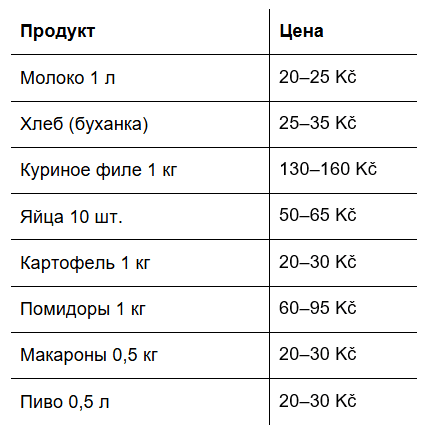
If you cook at home and shop wisely, one person can manage within 5,000–7,000 Kč per month for groceries. A family of two adults – about 9,000–12,000 Kč.
Cafes and Restaurants. Lunch in Prague costs 70–200 CZK and typically includes a business lunch: a main course, salad, dessert, and drink. This is called "denní nabídka" and is available in most establishments from Monday to Friday during lunch hours – a very convenient and economical option. A three-course meal in a mid-range restaurant for two will cost from 1,425 CZK. Standard fast food (McDonald's, KFC) costs about 200–250 Kč for a combo meal.
Transport: Public, Personal, and Taxi
Prague's public transport – metro, trams, and buses – runs smoothly and covers the entire city. This is one of the reasons why many residents don't own a car at all.
Tickets and Passes in Prague:
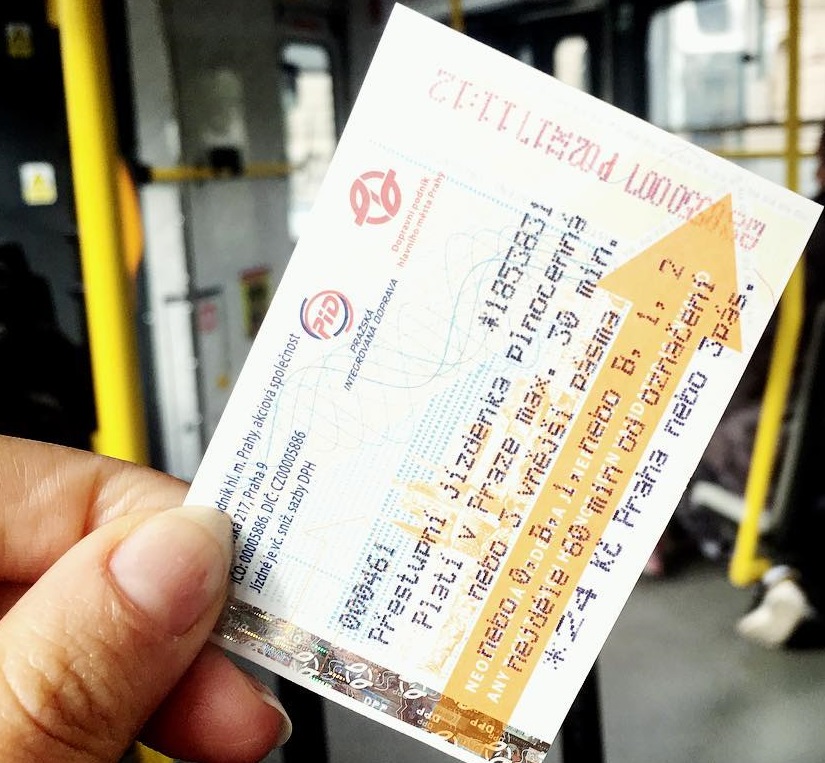
Single ticket for 30 minutes – 30 Kč
Ticket for 90 minutes (with transfers) – 40 Kč
For an adult passenger (18 to 60 years old), a monthly pass will cost 550 CZK, a quarterly pass (90 days) – 1,480 CZK, and an annual pass – 3,650 CZK. All passes are loaded onto a Lítačka card or a Visa/Mastercard bank card and are valid on metro, trams, buses, suburban trains, Vltava river ferries, and even the funicular.
In the regions, the transport network is more modest, but the need for it is generally less.
Personal Car. Gasoline in Czechia costs about 35–40 Kč per liter (2025 data). Add to this mandatory insurance, technical inspection, and parking – which is especially expensive in Prague's city center.
Taxi. Bolt and Uber services operate in Prague and major cities. A city trip costs 150–300 Kč depending on the distance.
Mobile Communication and Internet
The three main operators in Czechia are T-Mobile, O2, and Vodafone. Currently, mobile communication in Czechia is one of the most expensive in Europe. However, operators are gradually competing for customers, and it's quite realistic to find a reasonable plan. A budget plan with limited internet will cost 400–600 Kč/month. The cheapest unlimited plan is around 653–747 Kč per month, with Vodafone offering a speed of 4 Mbps, while O2 and T-Mobile offer over 10 Mbps at a price starting from 945 Kč.
Home Internet. The operator O2 offers fiber optic connections with a monthly fee ranging from 399 to 799 CZK, depending on the speed. This is one of the most common options. Vodafone and several regional providers offer similar conditions.
In total, for communication and internet, it's realistic to budget 700–1,500 Kč per month per person (mobile + home).
Medicine and Insurance
There are two health insurance systems in Czechia – public and commercial. Public insurance is available to Czech citizens, persons with permanent residence, foreigners employed by Czech companies, and refugees. Commercial insurance is required for foreigners with a long-term visa or long-term residence permit who are not employed by a Czech organization.
Public Insurance (for officially employed individuals): If the employer or the state does not pay insurance contributions, you will have to pay them yourself in 2025 – 2,808 Kč per month.
Commercial Insurance (for unemployed, students, entrepreneurs): the cost ranges from 7,000 to 15,600 Kč per year, which is 580 to 1,300 Kč per month.
Dentistry is a separate matter. Routine dental treatment is only partially covered by insurance or has limits (usually 5,000–6,000 Kč per year). A dentist visit starts from 500–800 Kč; more serious treatment or prosthetics will be significantly more expensive.
Entertainment and Leisure
Prague is not just about work and utilities. The city's cultural life is quite vibrant, and much of it is available at reasonable prices.
Cinema ticket: 200–380 Kč
Fitness club membership: from 1,000 to 2,000 Kč/month
Museum visit (National Museum, Prague Castle, etc.): 100–300 Kč
Beer in a bar: 50–80 Kč
Dinner for two in a restaurant (outside the tourist center): 600–1,200 Kč
For leisure, it's realistic to budget 2,000–5,000 Kč per month, depending on your lifestyle. If you want to save money, free parks, riverbanks, city festivals, and bike paths are always available.
Salaries: Context for Understanding the Budget
Expenses only make sense in relation to income. According to the Czech Statistical Office, in the first quarter of 2025, the average salary in Czechia was 46,924 Czech korunas. After deducting taxes and contributions (about 25–30% of gross), the average net salary is approximately 34,500 CZK.
As of January 1, 2025, the minimum wage in Czechia is 20,800 CZK – about 760 euros per month.
For a migrant without knowledge of the Czech language, the initial salary will often be closer to the minimum wage. This is important to consider when planning your budget.
Summary Table
Below is an estimated monthly budget for one adult in Prague. In the regions (Brno, Plzeň, Ostrava), the budget will be 20–35% lower – primarily due to rent.
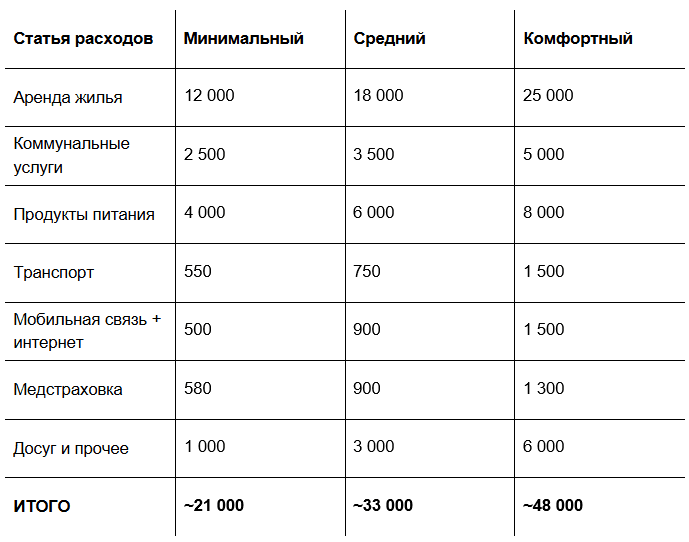
Living in Czechia is cheaper than in Germany, Austria, or the Netherlands, but noticeably more expensive than 5–7 years ago: rent has increased faster than salaries. The minimum for a decent life for one person in Prague is about **30,000–35,000 Kč per month**. If you are officially employed, insurance and part of the taxes are already included in the salary scheme. If you are opening a sole proprietorship (živnosť) or have arrived under other circumstances, budget these amounts separately.
Czechia is a country where you can live well with a sensible approach to spending. The main thing is to know the real numbers before you arrive.