
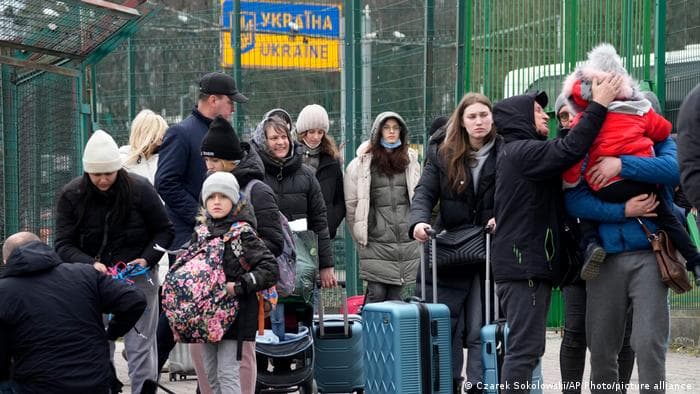
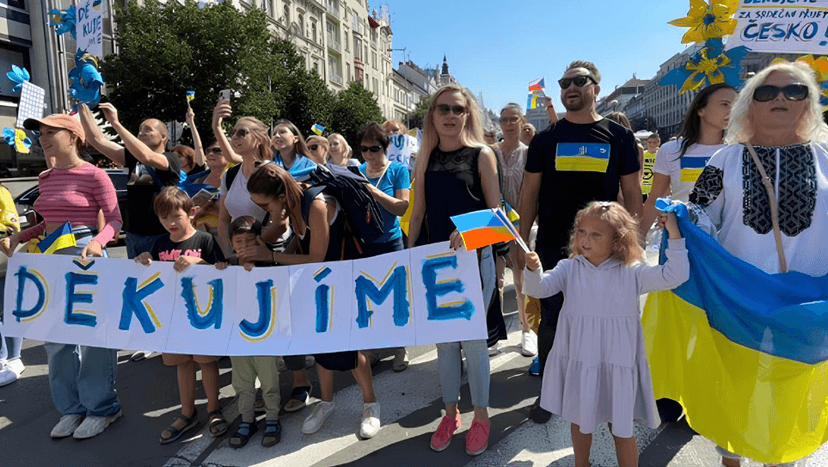
February 2022. At Prague's Main Station, volunteers stand with signs in Ukrainian. At Václav Havel Airport, blankets are being laid out. Private individuals offer rooms in their apartments to complete strangers – simply because it is the right thing to do. Three years later, the picture is different: there are more Ukrainians in the Czech Republic, they are working, taking their children to school, paying taxes – and are increasingly seen not as guests needing help, but as part of the country's daily life. Sometimes convenient, sometimes inconvenient. How has this coexistence changed, and what awaits Ukrainians next – we explore this in the article.

Numbers and Demographic Profile
The Czech Republic, a country with a population of about 10.9 million people, is today the absolute leader in the European Union in terms of the number of Ukrainian refugees per capita. According to Eurostat, there are about 36 Ukrainians with temporary protection per thousand inhabitants in the Czech Republic. For comparison, in Poland this figure is 26.54, in Germany – 14.85, and in France – only 0.77. According to the Czech Ministry of the Interior, by mid-March 2026, the number of people with temporary protection in the country had grown to 401,850. In addition to them, there are Ukrainians living in the Czech Republic who arrived before the war – taking all categories into account, the total number of Ukrainian citizens in the country exceeds 612,000. The majority are women with children who fled in the first months of the war. Of the total number of refugees, 28% are children and the elderly, and there are over 265,000 people of working age, of whom 60% are women. The demographic portrait has gradually changed: in the first year, it was a wave of mothers with children, later men joined, who left Ukraine for various reasons – both those seeking work and those avoiding mobilization.How Public Moods Have Changed
Spring 2022: A Wave of Solidarity
The first months of the war were a time of almost unconditional support. Czechs took Ukrainians into their homes, organized humanitarian collections, and volunteered at the border. Political consensus was rare in scale: helping Ukraine was seen as a moral duty of a country that itself experienced Soviet occupation. However, the protracted conflict gradually began to change public moods. As the war continued, questions about the burden on the state and social system were increasingly heard. A survey conducted in June 2025 showed that 58% of citizens believe that the Czech Republic has accepted too many refugees. The STEM Analytical Center also recorded an increase in critical assessments: more than half of Czechs are convinced that Ukrainians are placing an excessive burden on the state budget. At the same time, 60% of respondents stated that Ukrainians "receive more from the budget than they contribute to it." STEM emphasizes that official data indicate the opposite, but these figures have not yet changed mass perception.
A More Positive Outlook: January 2026
Despite growing fatigue, the picture remains ambiguous. A survey by Kantar CZ, conducted in January 2026 on behalf of Czech Television, showed that 54% of respondents believe it is necessary to continue military aid to Ukraine – this is 7% more than in October 2023. Furthermore, 69% of respondents are confident that Ukrainian refugees have successfully integrated into Czech society. 35% of Czechs now have a positive personal experience interacting with Ukrainians – 5 percentage points more than in October 2023. 30% show a neutral attitude (compared to 26% previously), and the share of negative impressions remains stable – around 20%.Why Opinions Differ So Much
Sociologist Jiří Táborský from the STEM center explains this gap quite simply: those who personally interact with Ukrainians and see their integration tend to have a more positive attitude towards them. Those who assess the situation abstractly, relying on political statements and public narratives rather than personal experience, are more critical.The Political Factor and Growing Polarization
Political rhetoric plays a separate role. For example, Tomio Okamura, the leader of the SPD movement, known for his anti-Ukrainian statements, claims that dissatisfaction in society is growing and points out that in Prague, allegedly, every third resident is a foreigner. Such statements are more likely to reflect increased polarization and attempts to use the migration issue in political struggles. However, similar rhetoric is becoming louder – and noticeably affects public moods.Ukrainians' Opinions
For Ukrainians themselves, three years in the Czech Republic means three years of very different experiences. Those who arrived in the first months have gone from shock and confusion to relative stability. Those who ended up here later found themselves in a different country – more tired, with stricter rules and less generous aid. A common theme in conversations is the gradual feeling of invisibility. The first year was a time of attention and compassion. Then Ukrainians seemed to "fit into the landscape" – and this in itself is not bad, but along with normalization came indifference. According to a UNHCR report from January 2026, almost 60% of surveyed refugees from Ukraine are working below their qualification level. A doctor works as a cleaner, a teacher – in a warehouse. The language barrier and non-recognition of diplomas are the main reasons for this. Some specialists do find their way into their professions: in medicine, IT, construction – but this requires time and effort that many simply do not have. The psychological dimension is a separate issue. Uncertainty of status, inability to make long-term plans, anxiety for relatives in Ukraine – all this creates chronic tension. Many Ukrainians live in a "one more year" mode – extending their protection, finding a job, giving their children the opportunity to study – without knowing what will happen next.
The Official Side of the Issue
In January 2026, the government in the Czech Republic changed: the ANO movement led by Andrej Babiš won the elections in coalition with the nationalist SPD of Tomio Okamura. This government is significantly less pro-Ukrainian than Petr Fiala's cabinet. According to Czech media, the new coalition plans to change the rules of temporary protection for Ukrainian refugees – in particular, to reduce social benefits.Temporary Protection Still in Place
Despite political changes, key support mechanisms continue to operate. In January 2026, the Czech Ministry of the Interior opened online registration for the extension of temporary protection visas. After completing two stages of the procedure, the status is extended for one year – until March 31, 2027. This extension will be the last under the general European directive. After March 2027, each EU country will decide independently what legal status to offer Ukrainians next.Special Long-Term Residence
The new government also approved a special long-term residence program for Ukrainian refugees. This mechanism is designed for economically active and financially independent individuals. It allows for obtaining a stable status for 5 years with the prospect of obtaining permanent residence. The program's formula is quite clear: you work, you pay taxes, you meet the requirements – you get the opportunity to stay in the country for a long time. Babiš's cabinet also discussed an amendment that allows repeating the process of obtaining special long-term residence in 2026 under the same conditions as in 2025. The deadlines are changing, but the basic requirements remain the same.Ukrainians Contribute More to the Budget Than They Receive
Economic data show that Ukrainian refugees have become a source of income for the Czech Republic, not a burden. In the third quarter of 2025, they paid about 340 million euros in taxes and fees to the budget – more than double the amount spent by the state on aid. The trend remains stable: since the third quarter of 2023, budget revenues related to the presence of Ukrainians have consistently exceeded expenditures, and the gap between them continues to grow. Since the beginning of the war, Ukrainian refugees have brought about 24.8 billion Czech crowns to the Czech Republic, while the state spent 15.5 billion on their support.The Role of Ukrainians in the Labor Market
The Czech Republic remains one of the EU countries with the lowest unemployment rate – about 3%. This is an indicator not of a crisis, but of a shortage of labor. Ukrainians have filled a significant number of vacancies, especially in industry, construction, logistics, and the service sector, filling niches where the country has long lacked workers.School Education in the Context of Migration
Among all aspects of Ukrainian integration, the school issue is the most telling: children integrate into the system more deeply and faster than adults, and it is in the classrooms that the future Czech-Ukrainian coexistence will be shaped. Today, tens of thousands of Ukrainian children are studying in Czech schools. For them, this is often the second or third academic year in a new country, with a new language and new rules. Some children already speak Czech fluently, while others still have difficulties. For several years, the state subsidized support programs: Ukrainian-speaking assistants worked in schools, and adaptation courses were available. However, in the first half of 2025, 193 educational institutions received 89 million Czech crowns for the support program, and from September 2025, the Ministry of Education stopped its funding – due to budget constraints. Schools can now only count on basic language courses from regional reserves. At the same time, in December 2025, an important legal change occurred: the Constitutional Court of the Czech Republic overturned the rule that allowed separate enrollments in primary schools for children of Ukrainian refugees. The court agreed with the senators that such a practice was discriminatory and could lead to segregation. On the one hand, this is a step towards equality. On the other hand, the disappearance of a special procedure may complicate access to education for the most vulnerable families.