
Czech Banking System: A Brief Overview
The Czech banking system is regulated by Česká národní banka (ČNB) — the Czech National Bank. It sets the rules, supervises the activities of financial institutions, and protects depositors. Deposits of natural persons are insured up to €100,000 under the European deposit insurance system.
The country's currency is the Czech koruna (CZK, Kč). Despite being an EU member since 2004, the Czech Republic has not yet adopted the euro and does not plan to do so in the foreseeable future. Accounts in banks are opened in korunas by default, although several banks offer multi-currency accounts.
Who Can Open an Account
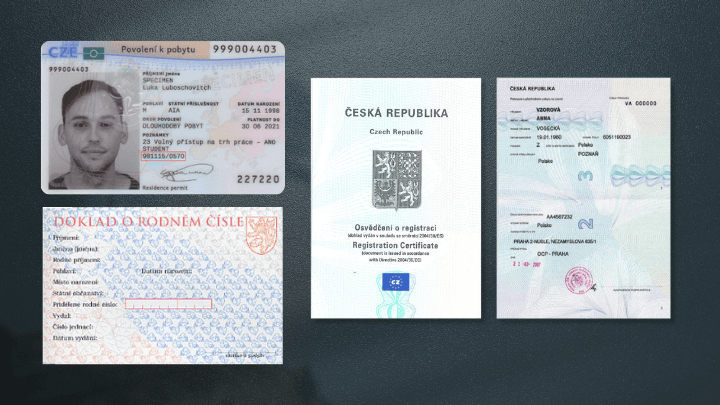
According to a European Union directive that came into effect on March 1, 2017, all banks are obliged to provide a so-called basic payment account to persons who have a legal right to reside in the European Union. If a foreigner requests to open an account in a Czech bank, almost all banks now require the presence of some long-term visa, residence permit (VNP), or similar status in the Czech Republic.
This means the following:
EU citizens can open an account by presenting only their passport or national ID — requirements for them are minimal.
Citizens from non-EU countries with a residence permit (přechodný pobyt — temporary residence permit, or trvalý pobyt — permanent residence permit) can open an account without significant obstacles.
Foreigners with a long-term visa (work, student, entrepreneur) can also usually open an account.
Tourists and short-term visitors practically cannot — without proof of legal long-term stay, most banks will refuse.
However, having a residence permit does not guarantee account opening by itself — the bank assesses each application individually. Each account opening application is considered by the bank separately. Banks have recently tightened their conditions, causing many clients to face difficulties.
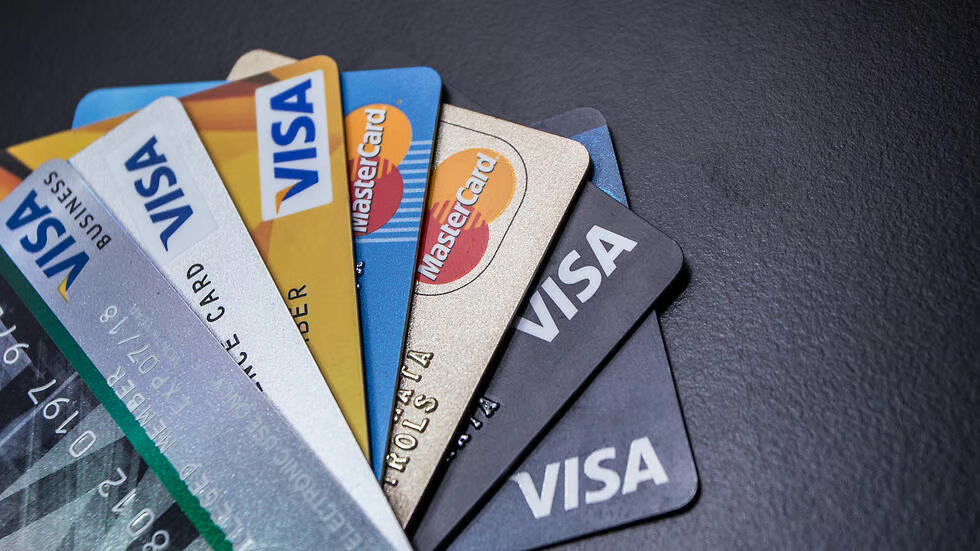
A basic payment account is a minimum set of banking services to which every legal resident of the EU is entitled, regardless of citizenship. It includes: opening and maintaining an account, cash deposits and withdrawals, direct debits and standing orders, money transfers from a debit card, issuing a debit card, and internet banking.
In practice, most banks do not differentiate between a "basic" and a "regular" account — foreigners have access to the same offers as Czech citizens.
Documents You Will Need
The standard set of documents for opening an account as a natural person is as follows:
International Passport — required.
Second Document — residence permit/biometric resident card, driver's license, or other identification document. A foreigner will need to provide at least two identification documents. One of them is the passport; the second can be a residence permit, driver's license, employment certificate, and others.
Proof of Address in the Czech Republic — rental agreement, registered address, or utility bill in your name.
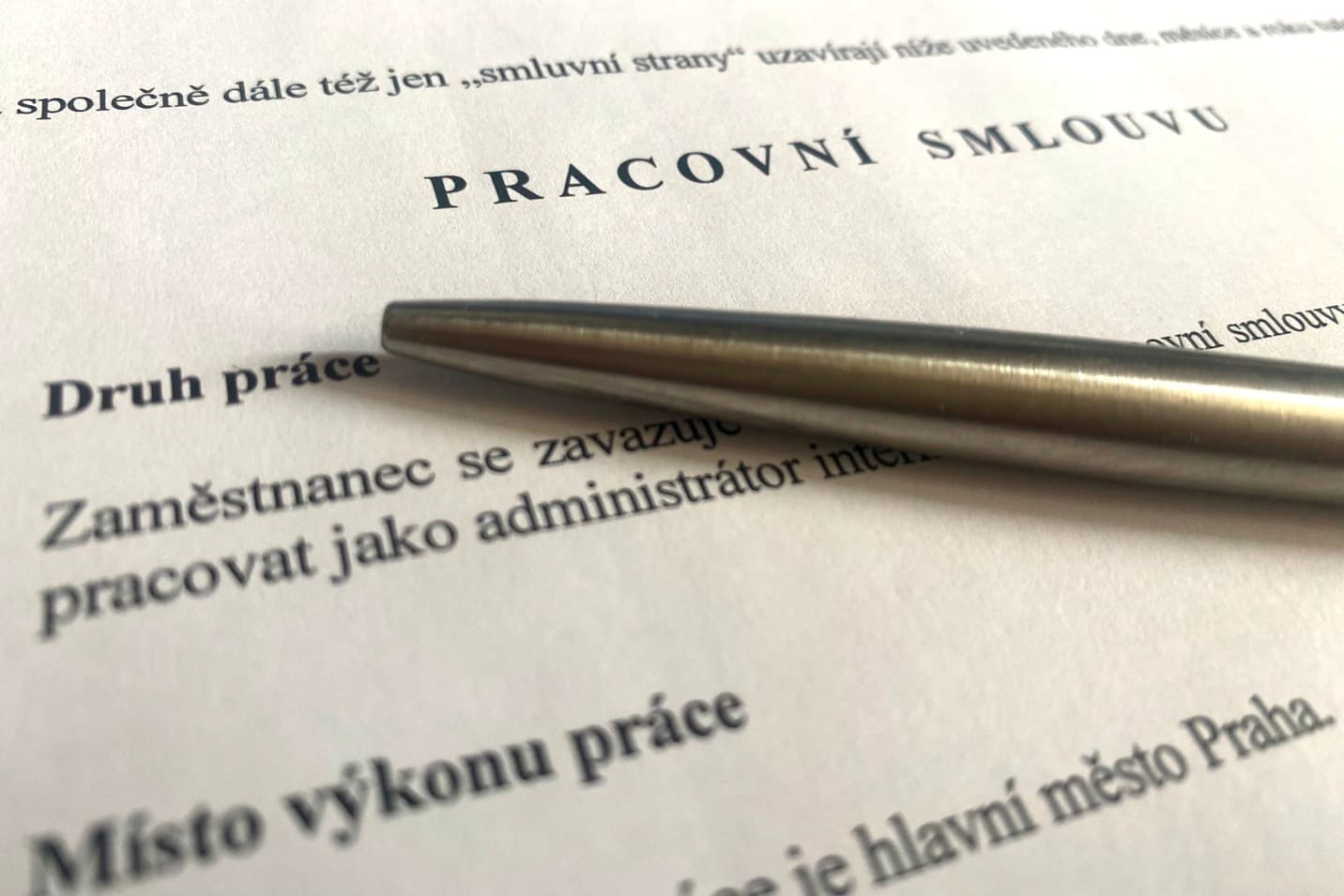
Information about the Source of Income — employment contract, salary statement, documents about entrepreneurial activity. When opening an account, the bank requests a copy of your ID, documents confirming your residence in the Czech Republic, and information about the source of funds.
Initial Deposit — not always, but several banks require a small amount to be deposited when opening an account.
For students, a certificate of enrollment from the educational institution may be additionally requested.
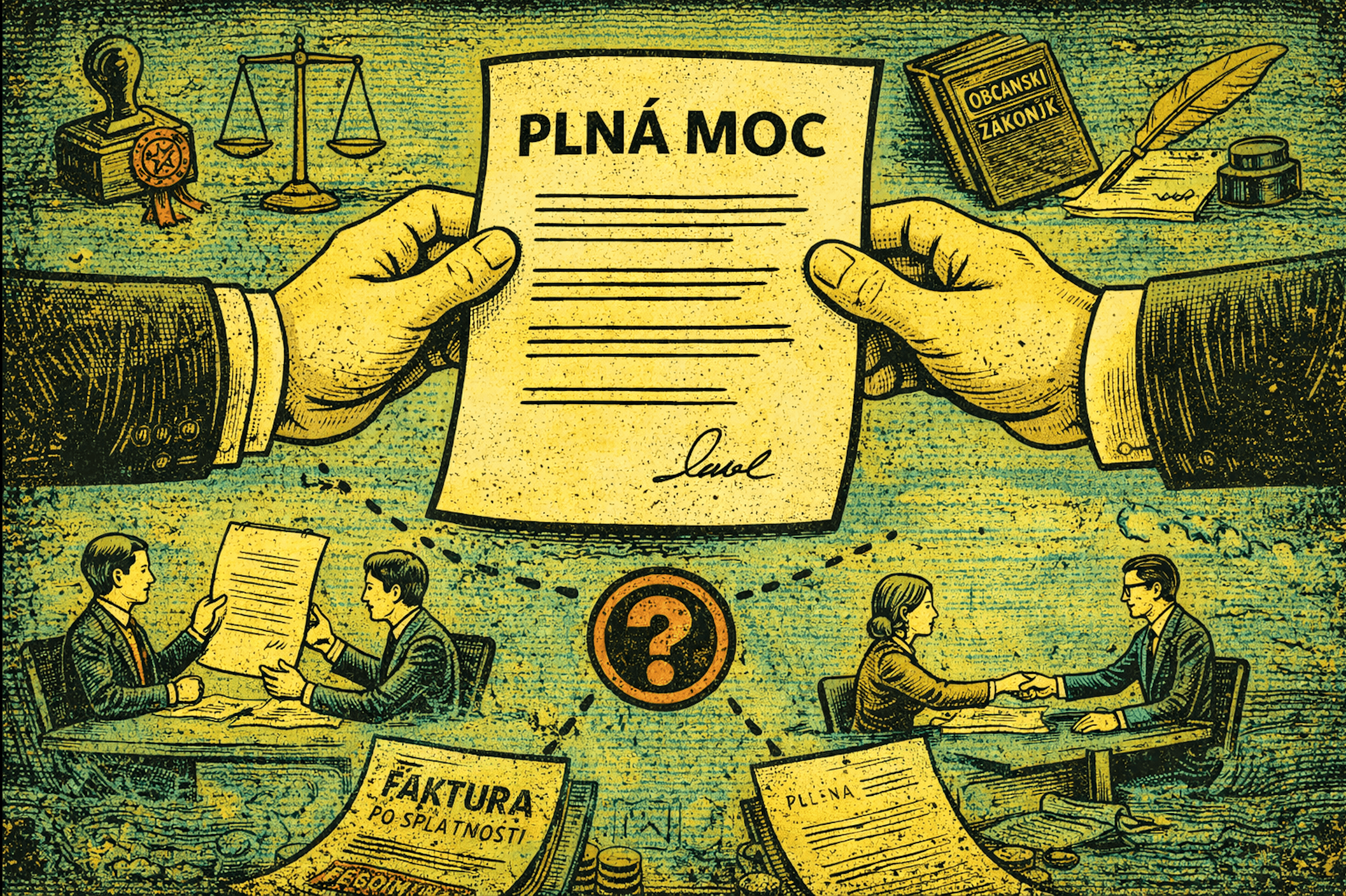
An account is opened at any branch of the chosen bank during a personal visit. There are options for opening an account online or by power of attorney, but not in all banks.

Overview of Major Banks for Foreigners
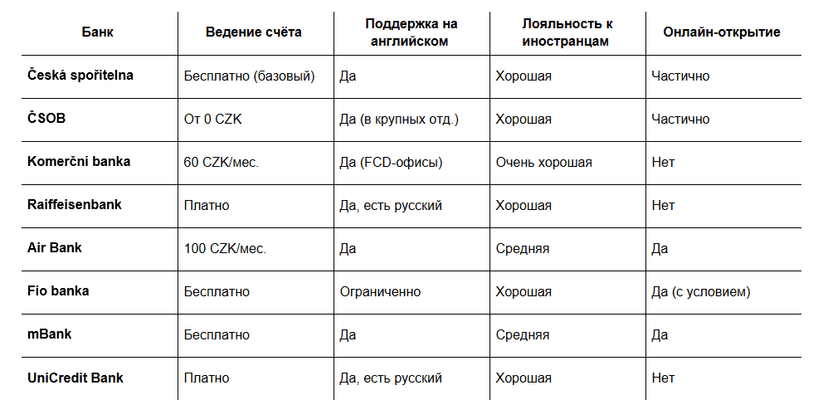
Below is a brief overview of the banks most frequently chosen by foreigners, considering their attitude towards non-residents, language support, and service costs.
Česká spořitelna
The largest bank in the Czech Republic, founded in 1825. It is part of the Austrian financial group Erste, which unites banks in Central and Eastern Europe. The internet banking works in three languages: Czech, English, and German. Account opening is possible both in person and through a representative by power of attorney.
It does not require a minimum non-reducible balance on the account and offers quite democratic tariffs. Basic account (Základní účet) for foreigners — free maintenance, outgoing payments — 5–7 CZK, ATM withdrawal — 5 CZK. SEPA transfers cost 220 CZK, SWIFT — 1% of the amount. Loyal, many branches, but requires two identification documents for account opening.
ČSOB
One of the largest universal banks. Offers a basic payment account specifically for foreigners. Good ATM network, developed mobile banking. Service is mainly in Czech; English is available in large branches in Prague.
Komerční banka (KB)
Komerční banka has organized Foreign Customer Desks (FCD) — special offices for foreigners where clients can get consultations in English, German, and Russian. This makes the bank one of the most friendly options for those who do not yet confidently speak Czech.
The main account costs 60 CZK per month, with a fee for outgoing payments — 6 CZK. SEPA transfers cost 195 CZK, SWIFT — 0.9% of the amount.
Raiffeisenbank
In Prague branches, Raiffeisenbank has English- and Russian-speaking staff. The bank is known for its loyalty to foreign clients. To open an account, Raiffeisenbank will ask to see your residence permit. Service is paid but competitive; there is a convenient mobile app.
Air Bank
A young bank with a strong focus on digital services. Account opening requires two documents. The basic account is comparable to the Grand tariff conditions: service costs 100 CZK per month, other services are free. The account is available in Czech korunas, euros, and dollars. SEPA payments — 25 CZK, SWIFT — 100 CZK.
Air Bank offers free cash withdrawals at its ATMs, with a fee for using other banks' ATMs.
Fio banka
Fio banka is a fairly loyal bank to foreigners, offering business accounts on the same terms as for natural persons, meaning free for many parameters that companies usually have to pay commissions for.
Current accounts are available in 14 currencies. For online account opening, you will need to provide two documents, as well as confirmation of an account in another Czech bank. This condition makes Fio banka more of a second bank than a first for newcomers. SEPA transfers — 20 CZK, SWIFT — 200 CZK.
mBank
A Polish online bank operating in the Czech Republic. Account management and creation are free, as are incoming and outgoing payments within the Czech Republic. The account is only in Czech korunas. SEPA payments — 25 CZK, SWIFT — 0.5% of the amount. Good mobile app, minimalist approach.
UniCredit Bank
In Prague branches, UniCredit Bank has English- and Russian-speaking staff. The bank is part of a large European group, offering a wide range of services to both natural and legal persons. A good option for those who value an international brand and developed support.
Step-by-Step Account Opening Process
Step 1. Choose a Bank
Decide what is more important to you: free service (mBank, Fio), support in Russian or English (KB, Raiffeisenbank, UniCredit), an extensive ATM network (Česká spořitelna, ČSOB), or a convenient app (Air Bank, mBank).
Step 2. Prepare Documents
Minimum set: international passport + residence permit/biometric card + proof of address in the Czech Republic + information about the source of income. It's better to bring both your employment contract and rental agreement — extra documents won't hurt.
Step 3. Make an Appointment or Visit a Branch
Most banks require a personal visit. At Komerční banka, it's better to choose an FCD branch in advance. Some banks (Air Bank, mBank) offer online opening, but only if you already have an active Czech account or biometric verification.
Step 4: Complete the KYC Procedure
KYC (Know Your Customer) is a standard banking identification procedure. An employee will check your documents, ask a few questions about the purpose of opening the account and the source of funds. Information about the source of funds (salary, payments, personal savings) must be provided to the bank representatives as part of the application.
Step 5: Receive Your Card and Account Details
The procedure takes no more than 1 hour if all documents are in order and on hand. In some banks, the card is issued immediately; in others, it is sent by mail within 5–10 business days.
Service Costs
Monthly service fees in Czech banks range approximately from 30 CZK. Several banks offer completely free account maintenance if certain conditions are met — for example, with regular incoming payments or a minimum card turnover.
Free or conditionally free service: mBank, Fio banka, Česká spořitelna (basic account). Paid: Komerční banka (60 CZK/month), Air Bank (100 CZK/month).
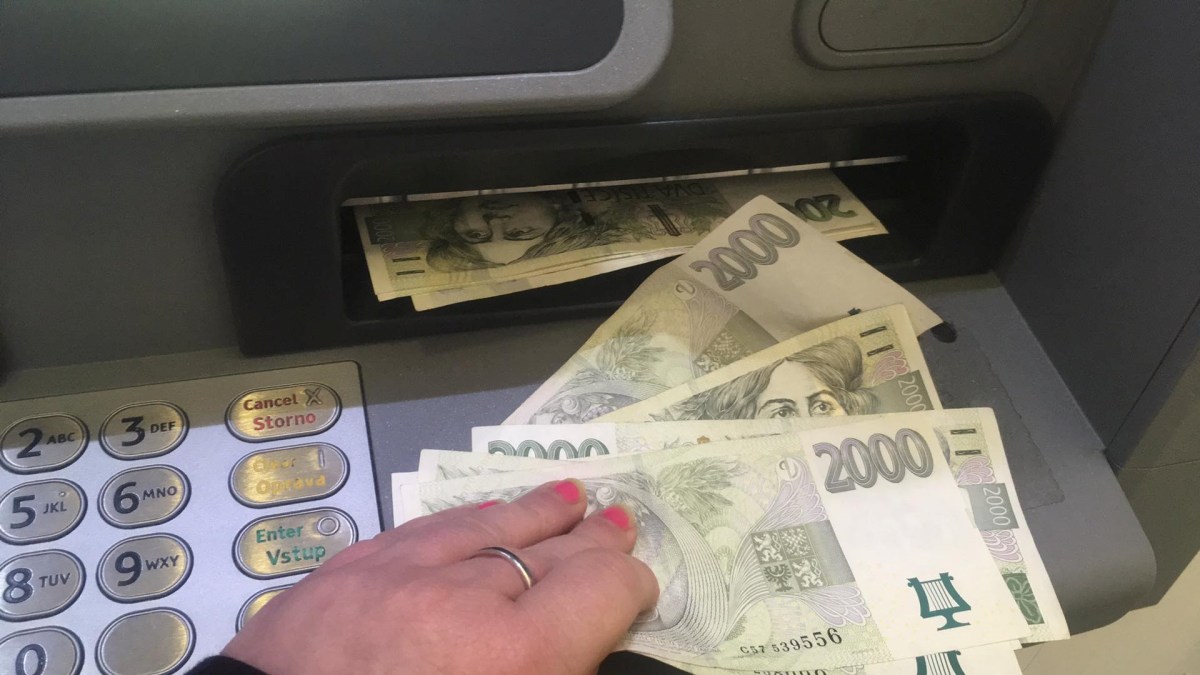
Withdrawals at your bank's ATM are usually free or cost 5–6 CZK. Česká spořitelna and ČSOB offer free withdrawals at their ATMs but charge a fee for using other banks' ATMs.
Transfers
This is one of the key parameters for a foreigner:
Transfers within the Czech Republic — usually free or very cheap (3–7 CZK).
SEPA transfers (to Eurozone countries and a number of other European countries) — from 20 to 220 CZK depending on the bank.
SWIFT transfers (to the rest of the world) — either a fixed amount or a percentage of the amount (0.5–1%).
For regular international transfers, it is better to use a separate tool like Wise or similar, as bank SWIFT fees can be quite significant.
Bank Account for Business
Self-Employed (živnostenský list / OSVČ)
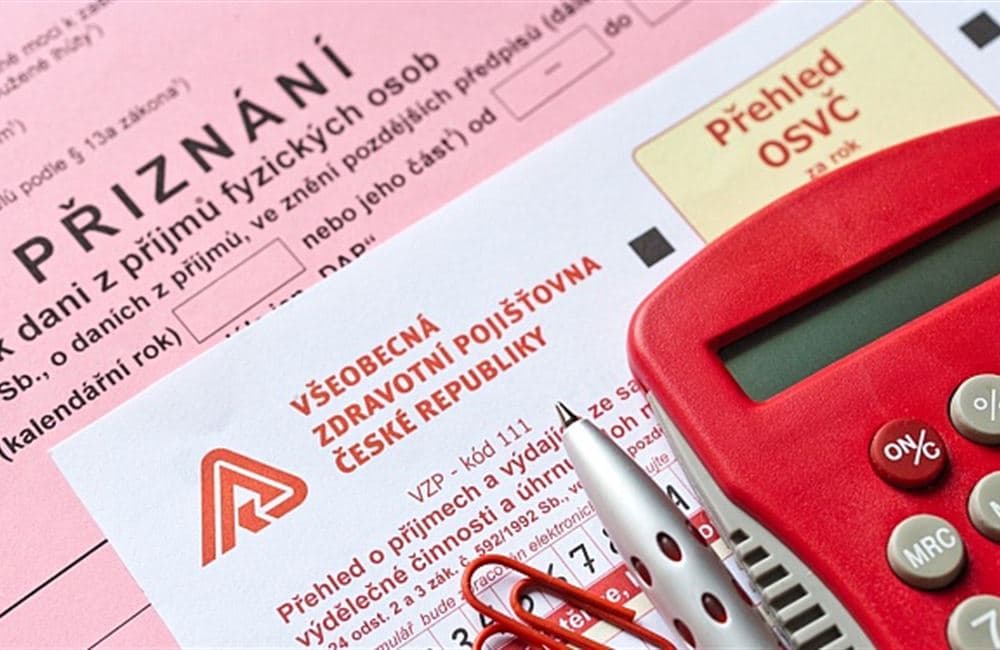
If you work in the Czech Republic as a self-employed entrepreneur (OSVČ — Osoba samostatně výdělečně činná), you are not legally required to have a separate business account — the law does not prohibit conducting business through a personal account. However, in practice, this creates confusion in accounting and can complicate interactions with the tax authorities.
Fio banka offers business accounts on the same terms as for natural persons, meaning free for many parameters that companies usually have to pay commissions for. This makes Fio particularly attractive for the self-employed.
To open a business account, you will need: a živnostenský list (trade license), a residence permit or resident card, and a passport. Some banks will also ask for tax registration (IČO — entrepreneur identification number).
Company (s.r.o. / LLC)
Opening an account for a Czech limited liability company (s.r.o.) is more difficult, especially if non-residents are part of the company's structure. Banks decide to open an account based on two main factors: whether the company's director has a residence permit (VHP) / permanent residence permit (PMP) or citizenship (they must be a resident of the country and apply in person at the bank) and whether the company has so-called "economic ties with the Czech Republic," meaning the company must conduct business with other economic entities in the country.
If a foreigner wants to open a business account in the Czech Republic, they must provide proof of commercial activity: a trade license, an officially certified extract from the commercial register of the country where the company was founded, with a certified translation into Czech.
The most welcoming banks for foreign entrepreneurs are Fio banka, Raiffeisenbank, and UniCredit Bank.
Practical Advice
Open an account as soon as possible. Right after getting your residence permit (VHP) or long-term visa — don't wait. The longer you are in the country, the more banking history you have for the bank.
Bring as many documents as possible. Even if officially only your passport and residence permit (VHP) are needed — bring your employment contract, rental agreement, and student ID. It's better to have too many documents than to have to come back again.
Start with banks that are friendly to foreigners. Komerční banka (FCD branch), Raiffeisenbank, UniCredit Bank, Česká spořitelna are reliable choices. Fio banka is good for those on a budget; Air Bank is for digital service lovers.
Don't rely only on neobanks. Wise and Revolut are useful tools, but they are not a replacement for a local account. You will most likely only receive your salary in the Czech Republic into a Czech bank account with a local IBAN.
Be prepared for questions about the origin of funds. Keep documents that confirm the source of your income handy — and don't take such requests personally.
The Czech banking system is open to foreigners — but with conditions. For most legal residents (EU citizens, Ukrainians, citizens of Asian countries, Latin America, etc.), the process of opening an account is relatively simple if you have the necessary documents. Citizens of Russia and Belarus will need to pay more attention to this matter: gather a full package of documents, demonstrate a stable resident status, and be prepared for an extended check. It is more difficult — but possible.
The Czech Republic remains a country with a reliable banking system, reasonable fees, and a wide choice of institutions. Finding "your" bank here is quite possible for everyone — you just need to know where to go and what to bring with you.
Bank conditions can change — it is recommended to check information on the official websites of the institutions before opening an account.