
The reason is usually not that you did something wrong. It's simply that the Czech system of utility payments works differently than in many other countries: you pay advances (zálohy) all year, and at the end of the period, a reconciliation (vyúčtování) takes place, which can either return money to you or require an additional payment. Understanding the logic of this system will help you take control of your budget.
In this article, we will break down everything step by step: what is included in utilities, how advances work, when and how reconciliation is done, who is responsible for what, and what specifically needs to be done to avoid surprises.
How the Utility Payment System Works
The key feature of the Czech system is advance payments (Zálohy). Every month, you transfer a fixed amount for utility services, but this is not the final figure. It's just the estimated cost of consumption, calculated based on last year's data or statistical averages.
At the end of the year, the supplier or management company checks how much you actually consumed and how much you have already paid. If you paid more, they return the difference (přeplatek). If you paid less, you pay the difference (nedoplatek). It is this underpayment that becomes the unexpected bill.
This is a normal, legal, and generally accepted practice in the Czech Republic. Problems only arise when the advance payments are initially too low, or when actual consumption turns out to be significantly higher than estimated.
What is Included in Utility Payments
Depending on the type of housing and the contract, they may include:
Electricity (elektřina) — usually a separate contract with the energy supplier.
Gas (plyn) — also a separate contract if the apartment is gas-heated.
Central heating and hot water (teplo a teplá voda) — connected through the management company; about 40% of Czech households use central heating.
Cold water and sewage (studená voda a stočné) — usually through the SVJ or správce.
Waste disposal (odvoz odpadu) — a municipal fee, paid separately to the city hall in some towns.
Elevator maintenance, cleaning of common areas, stairwell lighting — included in building-wide expenses.
Repair fund (fond oprav) — contributions for future building repairs (relevant for apartment owners and SVJ members).
It is important to understand: not all of these items are necessarily included in your monthly payment to the landlord. Some may be included in the rent, and some may be paid separately. Everything depends on the terms of the contract.
There are several levels of responsibility in the Czech system, and it is important to understand who exactly stands between you and the service provider.
Správce budovy / správcovská firma — the management company. It handles building maintenance, enters into contracts with heat and water suppliers, manages settlements with residents, and issues the vyúčtování.
SVJ (Společenství vlastníků jednotek) — the homeowners' association, similar to our OSBB. If you rent an apartment from a private owner who is a member of the SVJ, the SVJ issues the bill to the owner, and the owner then bills you.
Pronajímatel (landlord) — if you rent a property, they are obliged to provide you with the vyúčtování within the specified deadlines. By law, landlords who directly pay energy bills are required to provide residents with a detailed report annually — a breakdown of all expenses and payments, including actual costs, advance payments made, and the final balance. Upon request, the landlord is obliged to show the original invoices from the suppliers.
Energy suppliers (dodavatelé energií) — ČEZ, E.ON, PRE, and others. They issue the bill directly to the person whose name is on the contract — this could be the resident, the apartment owner, or the management company.
Vyúčtování — Annual Reconciliation
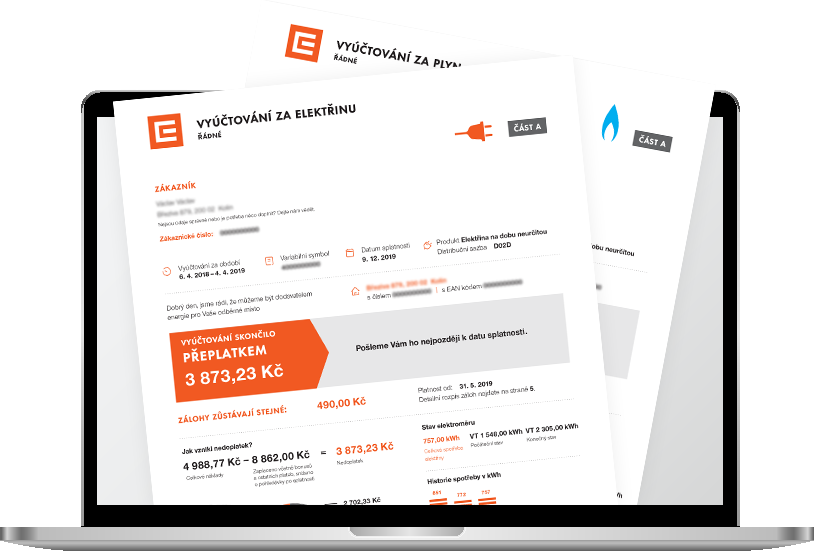
Vyúčtování is the official final document for the billing period (usually the calendar year). It states how many services were actually consumed, how much you paid in advance, and what the difference is.
Suppliers are obligated to issue and deliver the vyúčtování to end consumers no later than April 30 of the following year — this is stipulated in § 7 of Act No. 67/2013 Coll. This means that for 2025, you should receive the vyúčtování by April 30, 2026.
For direct contracts with energy suppliers (ČEZ, E.ON, PRE), the deadline may vary: if you have an annual billing cycle, you are required to pay regular advances, and once a year you receive the vyúčtování. The number of advances, their amount, and payment deadlines are indicated in the advance payment plan and in the vyúčtování itself.
How the Difference is Calculated
The logic is simple: actual consumption from the meter × current tariff − amount of advance payments made = underpayment or overpayment
The vyúčtování document shows the initial and final meter readings, the calculation of consumption at high and low tariffs, total consumption, and information on whether the advances will change for the next period or remain the same. The amount of advances can be changed directly in the vyúčtování document.
For heat and hot water, the calculation is more complex: it depends on the building-wide expenses, which are distributed among apartments based on heat meters (měřiče tepla) or by area — depending on the method chosen by the SVJ.
Why the Bill Turns Out to Be Large
Here are the most common scenarios where migrants receive unexpectedly large underpayments:
Advances were too low when you moved in. If the previous resident consumed little, and you live more actively — the advances calculated based on their consumption will not cover you. When moving in, it's always worth clarifying on what basis the amount was calculated and, if necessary, asking for it to be reviewed.
Meter readings were not submitted. If the supplier did not receive actual data, they billed based on estimated consumption (odhadovaná spotřeba). When the actual odečet finally arrives — the difference can be significant.
Sharp increase in energy prices. Advances are calculated based on last year's prices, but tariffs changed during the year. This is especially relevant for customers with indefinite contracts, which account for about half of all electricity consumers in the Czech Republic.
Many residents, billing by the number of people. Some utility services (water, waste disposal) are divided among apartments based on the number of registered residents. If you did not report a change in the number of residents — the reconciliation may be incorrect.
Cold winter or hot summer. Increased consumption of heat or water objectively increases the final amount.
If the vyúčtování is not issued within the specified deadline (4 months after the end of the billing period), the supplier loses the right to demand payment for the underpaid advances. This is an important point: a delay in the document is not just a formality, it is your legal argument.
The standard period for financial settlement — for both overpayments and underpayments — is 4 months.
If there are errors in the vyúčtování, you have the right to make a complaint (reklamace). It is recommended to submit a complaint in writing, indicating the apartment address, user's name, and the unit number to which the claim relates.
Energy Suppliers
The Czech energy market is liberalized: you have the right to choose your supplier independently. The main major players are:
ČEZ — the largest supplier, a state-owned concern, covers most of the country.
E.ON — operates mainly in South and West Bohemia and Moravia.
PRE (Pražská energetika) — serves Prague and its surroundings.
Pražská plynárenská — gas supplier in Prague.
innogy / RWE (now E.ON after merger) — one of the large structures in the gas market.
Dozens of smaller suppliers and aggregators.
Distribution (i.e., the physical transmission of electricity through networks) is regulated by the state and does not depend on the choice of supplier — you pay for it in any case. The regulated component of the electricity price is determined by the Energy Regulatory Office (ERÚ) and in 2026, it decreased on average by about 15%.
How to Choose a Supplier and Tariff
In 2025–2026, electricity and gas prices in the Czech Republic continue to fall. The average price of electricity was about 2.44 crowns per kWh, and gas costs on average about 1,500 crowns per MWh.
When choosing a tariff, pay attention to the following parameters:
Fixní cena (fixed price) — the price is fixed for the contract term, providing predictability. Especially beneficial during periods of market instability.
Variabilní cena (variable price) — the price changes according to the market. It can be beneficial when prices fall, but carries risk in the opposite situation.
Dvoutarifní sazba (two-tariff meter, D02d, etc.) — lower price at night or if you have an electric boiler / heat pump. Relevant if you have electric heating.
To compare offers, we recommend using the independent ERÚ calculator (srovnavac.eru.gov.cz) or the TZB-info calculator (kalkulator.tzb-info.cz) — both work without registration and personal data.
If necessary, the supplier can be changed. This is the legal right of every consumer. If the contract is in your name, you can apply for the change yourself. Technically, the process takes about 3 weeks, without interruptions in electricity or gas supply.
However, if the contract is in the name of the landlord or management company — they, not you, make the decision to change the supplier. In this case, you can only initiate negotiations.
Meters, Readings, and Your Responsibility
In the Czech Republic, there are two main ways of taking meter readings:
Dálkový odečet (remote reading) — modern meters transmit data automatically. In this case, your participation is not required. The accuracy of this system is 99.6%, which practically eliminates data transfer errors.
Ruční odečet (manual submission) — if the meter is not equipped with remote transmission, you take the readings yourself and submit them to the supplier or management company. The deadlines and methods of submission (online, by phone, by mail) are indicated in the contract or on the supplier's website.
Planned annual odečet is usually carried out at the end of the year or upon request. Some companies send a technician to the site.
If there are no actual readings, the supplier calculates consumption based on a norm — so-called odhadovaná spotřeba (estimated consumption). This is a statistical average that may not match reality. If you consumed more than the norm — a large nedoplatek will arise during the planned odečet. If you consumed less — a přeplatek will be formed, but the money will be "frozen" with the supplier until the reconciliation.
The conclusion is simple: regular submission of readings is in your interest. It allows you to adjust advances to actual consumption and avoid unpleasant surprises.
Heat Meters — A Special Case
Heat meters (měřiče tepla, indikátory vytápění) are installed on each radiator or at the apartment entrance. Their readings affect how heating costs are divided within the building. This is especially important for residents connected to central heating due to high price variations and system efficiency in different regions.
If a heat meter is not working or is damaged, you should inform the management company. Otherwise, your consumption will be calculated based on a standard rate, which might be higher than your actual use.
How to Avoid a Huge Bill
When Moving In, Check Advance Payments and Record Readings
This is the most important step that many people miss. As soon as you move into an apartment:
Take photos of all meter readings (electricity, gas, water, heat) with the date and send the data to the landlord or management company in writing.
Find out what readings the current advance payments (zálohy) are based on. If the previous tenant was one person and you will be two, the advance payments for water and heating might be too low.
Ask for the zálohy to be adjusted if you have reason to believe they are not correct.
Experts recommend setting advance payments based on actual consumption. In some cases, high usage might be caused by faulty appliances or unauthorized connections.
Monitor Your Consumption Throughout the Year
Take meter readings once a month and write them down. This takes two minutes but gives you a full understanding of your usage.
Compare your actual consumption with the amount of your advance payments. Most major suppliers (ČEZ, E.ON, PRE) have online accounts or mobile apps where you can track your consumption trends.
If you see that your actual consumption is consistently higher than what is included in your advance payments, ask for the amount to be reviewed. You can do this at any time, without waiting for the final bill (vyúčtování).
Saving Money: Practical Steps
Smart saving is not about living without, but about managing resources wisely. Here are a few proven methods:
Heating:
Lower the temperature at night and when you are not home by 2–3°C. Thermostatic radiator heads (termostatické hlavice) can do this automatically.
Do not block radiators with furniture or curtains, as this reduces heat exchange efficiency.
Ventilate your home intensely but for short periods (5–10 minutes), rather than leaving a window constantly slightly open. This way, heat escapes much faster.
Hot Water:
Taking a shower uses 3–4 times less hot water than a bath.
A faucet with an aerator reduces water flow without losing comfort.
Electricity:
If you have a two-tariff meter, run energy-intensive appliances (washing machine, dishwasher) during the night (nízký tarif - low tariff).
Turn off appliances completely, do not leave them in standby mode (waiting/low consumption).
LED bulbs use 5–8 times less electricity than old incandescent bulbs.
If You Still Receive a Large Bill
First, do not panic or ignore the document. Second, act step by step:
Check if the calculation is correct. Compare the meter readings on the bill (vyúčtování) with your records. Check if the number of residents, address, and billing period are correct.
Submit a complaint if there are errors. The complaint must be submitted in writing to the supplier or administrator (správce). If the supplier does not resolve the issue, the consumer has the right to contact the Energy Regulatory Office (ERÚ). According to 2023 data, about 1,000 complaints about unresolved overpayments were filed with ERÚ, and several suppliers were fined.
Ask for an installment plan (splátkový kalendář). If the amount is objectively large and there are no disputes about the calculation, most management companies and suppliers are willing to arrange phased payments. The request must be submitted in writing.
Seek free legal advice. The organization dTest (dtest.cz) protects consumer rights and offers advice on utility matters in Czech. For foreigners, the organizations Poradna pro integraci and Centrum pro integraci cizinců also provide services.
Section 6. State Housing Payment Assistance
6.1. Dávka státní sociální pomoci (superdávka) — "Super Benefit" from 2026
A major reform of social benefits came into effect in the Czech Republic on October 1, 2025. The new state social assistance benefit (DSSP), known as the "super benefit," replaced four previous benefits: housing contribution (příspěvek na bydlení), housing supplement (doplatek na bydlení), child allowance (přídavek na dítě), and subsistence benefit (příspěvek na živobytí). Peníze.cz
The benefit amount is calculated for the entire household. It considers the household's composition, number of members, their income, work activity, and housing costs, including utility payments in some cases. A mandatory condition is passing an asset test, which checks the number of properties and cars owned, as well as the amount of savings in bank accounts. Kurzy.cz
You can apply online through the Klientská zóna Jenda — on the website or in the mobile app (available on Google Play and the App Store). You will need an Identity občana (Citizen's Identity) to log in, for example, through bank identification or Mobilní klíč eGovernmentu (eGovernment Mobile Key). Up
6.2. Who is Eligible: Important for Foreigners
Not only citizens of the country are eligible for social benefits in the Czech Republic. The following individuals can apply:
Citizens of EU countries and their family members registered in the Czech Republic.
Citizens of third countries with a valid residence permit (povolení k pobytu), including long-term (dlouhodobý pobyt) or permanent (trvalý pobyt) residence.
The key condition is actual residence in the Czech Republic and documented housing expenses. Not having a registered address at your actual place of residence may complicate receiving benefits, so it is important to inform the authorities about your address promptly.
6.3. Where to Apply
Úřad práce České republiky (Labour Office of the Czech Republic) — This is where you submit the application for the super benefit. You can find the nearest office on the website up.gov.cz.
Klientská zóna Jenda — The online portal for submitting applications without visiting an office.
Centrum pro integraci cizinců (Center for Integration of Foreigners) — Helps foreigners understand documents and their rights in Czech and other languages.
Conclusion: Resident's Checklist
Instead of a long summary, here is a specific list of actions.
When Moving Into an Apartment:
Take photos of all meters with the date
Send readings to the landlord/administrator (správce) in writing
Find out what the advance payments are based on
Check if utility services are included in the rent or paid separately
Clarify who the electricity and gas supplier is
Every Month:
Take and record meter readings
Ensure advance payments match actual consumption
Once a Year (by April 30):
Receive the final bill (vyúčtování) from the landlord or management company
Check if all figures are correct
If there are errors, submit a written complaint (reklamace)
If there is a large additional payment (nedoplatek), request an installment plan (splátkový kalendář)
If You Encounter Difficulties:
Contact the supplier directly
If the dispute is not resolved, contact ERÚ (eru.gov.cz)
For free advice, contact dTest or Centrum pro integraci cizinců
The system of utility payments in the Czech Republic is logical — but only if you know its rules. Most stories about huge bills at the end of the year have one thing in common: the person did not know what they needed to do. Now you know.