
The Czech Republic has long been a multicultural country. Today, one in ten residents of the republic is a foreigner. In a few decades, the country, which still accepted students from Vietnam during the Soviet era, has become one of the main migration centers in Central Europe — and recent years have only accelerated this process.
How Many Foreigners Are in the Czech Republic and Who Are They
According to the Ministry of the Interior of the Czech Republic, as of December 31, 2025, 1,131,197 foreign citizens legally resided in the country — 37,000 more than a year earlier. Today, one in ten residents of the Czech Republic is a foreigner: their share is 10.38% of the total population of the republic. This is a record high for the country's history.
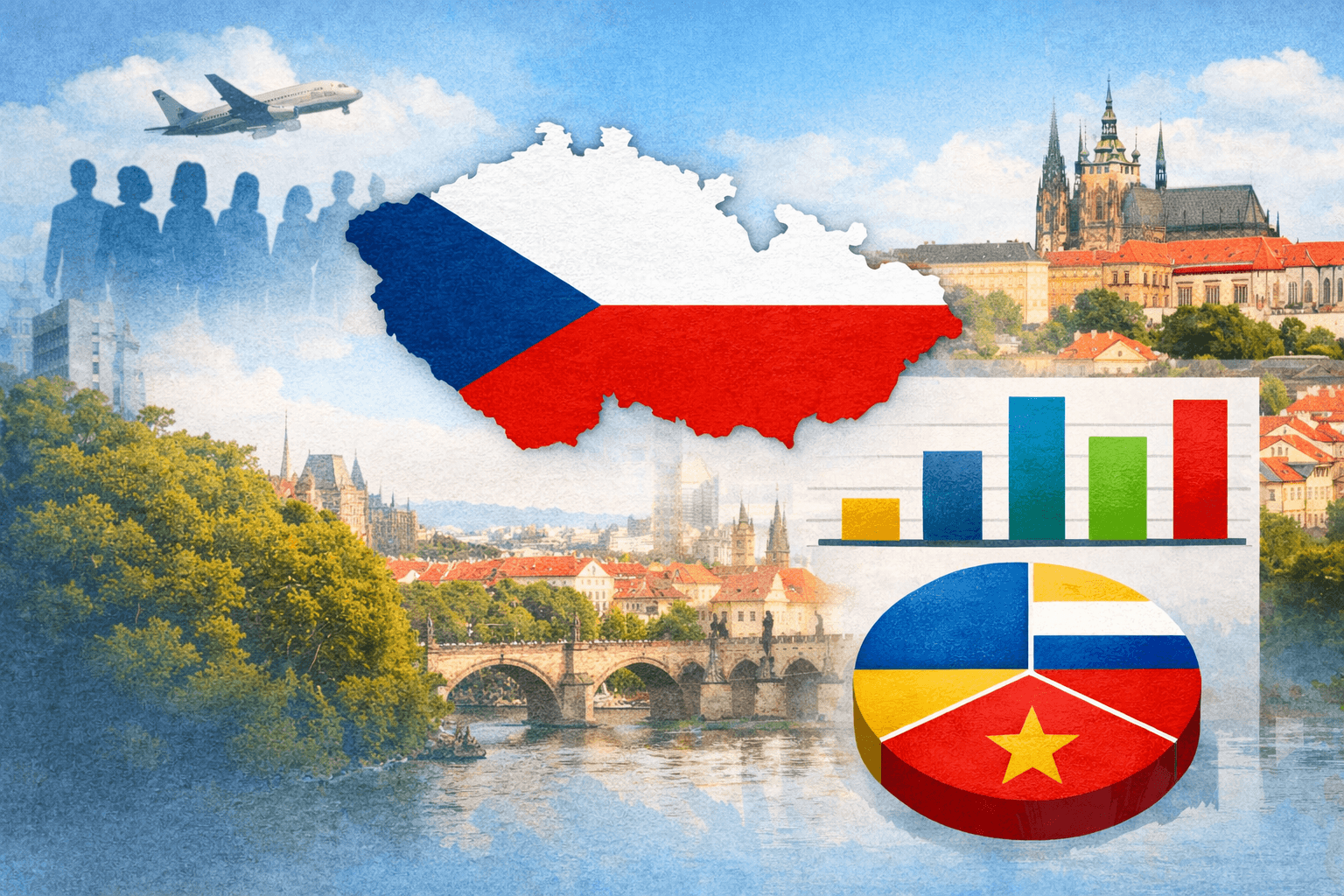
The vast majority are citizens of third countries (i.e., countries outside the EU) — 79%, or 894,607 people. The largest diaspora by the end of 2025 were citizens of Ukraine — 612,953 people (54.2% of all foreigners). In second place are citizens of Slovakia (125,280 people, 11.1%), in third place are citizens of Vietnam (69,685 people, 6.2%), and in fourth place are citizens of Russia (37,524 people, 3.3%).
Looking at the types of permits: the most common grounds for temporary stay for citizens of third countries are employment (105,981 people), family reunification (55,362 people), and education and scientific activities (28,492 people).
Citizens of EU countries form a separate group: over 234,500 citizens of the EU, EEA, and Switzerland, which is about 21% of the total number of foreigners. Among them, Slovaks, Poles, and Romanians traditionally prevail.
Ukrainian Diaspora
Ukrainians in the Czech Republic represent a separate story that does not fit into ordinary migration logic. Before 2022, there were about 200,000 of them. Then, after February 2022, the numbers began to grow rapidly.
For the entire year 2025, the Czech Republic issued 89,358 temporary protection visas. Per capita, the Czech Republic accepted more Ukrainian refugees than any other EU country. As of December 31, 2025, there were 393,056 valid temporary protection visas in the country. Ukrainian refugees accounted for 3.61% of the total population of the republic — meaning there were 36 refugees per thousand inhabitants. Of the total number of refugees, 22.7% were children and adolescents under 18, and 4.5% were pensioners.
An important nuance: not all Ukrainians in the Czech Republic are refugees. The total figure of 613,000 includes those who came before the war for work or study reasons. As of April 2025, 158,800 temporary protection holders were officially employed in the country.
The economic contribution turned out to be more significant than many expected. In the first three months of 2025, Ukrainians contributed over 124.5 million euros more to the state treasury through taxes and contributions than they received from it in social benefits and other support. The Czech Ministry of Labor acknowledged with no small pride: *"In many sectors, such as construction, agriculture, gastronomy, and healthcare, we can hardly do without their labor now."*
Since 2025, a new opportunity has opened up for some Ukrainians: temporary protection holders have gained the right to apply for a special long-term residence permit, which grants the right to live and work in the Czech Republic for at least another five years, and potentially to apply for permanent residence. Over 82,000 people have already expressed interest in the new status.
Regions: Where Foreigners Live
The distribution of foreigners across the Czech Republic is uneven, and this is not accidental — it accurately reflects the country's economic geography.
Prague remains the undisputed center of attraction. More than a third of all foreigners are concentrated in the capital. Among Ukrainian refugees, 26% of the total number live in Prague. In the capital itself, the proportion of immigrants reaches 13% — Ukrainians, Slovaks, Vietnamese, Russians, Germans, and Poles are concentrated here.
Central Bohemian Region is traditionally second in terms of the number of foreigners: 14.2% of the total number of foreigners in the country. Among Ukrainian refugees, 14% of their total number live in this region.
South Moravian Region, led by Brno, ranks third. About 10% of Ukrainian refugees are concentrated there. Brno is a university and technology city that attracts more qualified migrants: students, IT specialists, and engineers.
Plzeň Region and Ústí nad Labem Region traditionally attract foreigners employed in manufacturing. The industrial zones around Plzeň with its famous factories, as well as the border areas of the Ústí nad Labem Region, are places of particular concentration for labor migrants.
The Vietnamese diaspora deserves special attention, as it has its own unique map of presence. The largest group of Vietnamese lives in Prague, and 2% of the population of Karlovy Vary Region are Vietnamese citizens. The center of the diaspora's concentration is the border town of Cheb, as well as the northern part of Bohemia — the Varnsdorf area. This is not accidental: border markets and trade have historically become a niche for Vietnamese businesses in the Czech Republic. The Vietnamese market SAPA, located on the outskirts of Prague, covers an area of 25 hectares and has three thousand stalls.

Cities and the Labor Market
The unemployment rate in the Czech Republic has consistently remained below 3% — 2.6% in 2024. This is one of the lowest rates in the EU, and it is precisely this that makes the country so attractive to labor migrants: there are objectively more jobs than people willing to fill them.
For foreigners, the choice of city largely determines the nature of the work. Prague is the capital of opportunities for skilled specialists: IT, finance, international companies, services. Brno is technology, pharmaceuticals, and the university environment. In smaller cities, such as Ostrava or Plzeň, there are more offers for drivers, warehouse workers, and production workers.
The average salary in Prague is 55,000 CZK, in Plzeň Region — 46,600 CZK, in South Moravia — 42,000 CZK, and in Moravian-Silesian Region — 37,000 CZK. The difference is significant, and migrants take this into account.
How Migration Has Changed
To understand the current picture, one comparison is enough. The number of legally residing Ukrainians sharply increased after Russia's invasion of Ukraine in early 2022 — from just under 200,000 in 2021 to over 635,000 in 2022. There has never been such a surge in the history of Czech migration. But the Ukrainian crisis is only the most visible trend. More structural processes lie behind it.
Diversification of migration sources. The composition of foreigners is becoming increasingly diverse. The number of citizens of Kazakhstan increased to 10,510 people in the first three months of 2025. In terms of irregular migration in 2024, detected illegal immigrants were predominantly citizens of Ukraine, Moldova, and Vietnam, while at the external Schengen border, they were citizens of Georgia, Great Britain, and Turkey.
Decrease in the number of Russians. New migrants from Russia are practically not arriving in the Czech Republic: the country stopped issuing them almost all visas and residence permits immediately after the full-scale invasion of Ukraine. At the same time, Russians who have lived in the republic for a long time are obtaining Czech citizenship and are falling out of the overall statistics of the Ministry of the Interior.
Strengthening and simultaneous streamlining of policy. Since January 2026, amendments to the asylum law and the law on the residence of foreigners have come into force in the Czech Republic, allowing authorities to more quickly and effectively deport migrants who are in the country illegally and abuse the system. At the same time, new legal pathways are opening up for labor migrants.
Long-term forecast. According to a study by Boston Consulting Group and Aspen Institute Central Europe, the number of foreigners in the Czech Republic could grow to 1.36 million by 2035, with up to 260,000 Ukrainian refugees potentially choosing permanent residence. At the same time, about 1.2 million Czechs are expected to retire, making migrants a key part of the future workforce and economy.
Integration of Newcomers
Migration is not just about residence permits and work cards. It is also about how people establish themselves in a new place.
Education. As of early 2025, about 55,000 students from abroad are studying at Czech universities — the largest number of students are from Slovakia, Russia, and Ukraine. Children of foreigners have the right to free school education on par with Czech citizens, and in schools with a large number of non-native speaking students, special adaptation classes are available.
Citizenship. The path to a Czech passport is long. Standard naturalization requires 10 years of legal residence, passing a language proficiency test, and confirming integration. From 2019 to 2023, 28,797 people obtained Czech citizenship. In 2023, 6,389 people became citizens, with Ukrainians, Russians, and Slovaks being the most frequent nationalities among new citizens. In 2024, 2,943 foreigners applied for citizenship, and 2,447 of these applications were approved.
Language as the main barrier. Most specialists working with migrants identify the lack of knowledge of the Czech language as the main obstacle to full integration. Most refugees still work in low-skilled positions, such as construction laborers or production workers — precisely because the language barrier prevents access to more complex positions, even with education and experience from their home countries.

The Czech Republic, which in the 2000s was perceived primarily as a transit or temporary work country, is becoming a country of permanent residence for hundreds of thousands of people from different parts of the world. A million foreigners is no longer an exception, but the norm. And considering the demographic pressure (aging population, labor shortages), the role of migrants in the country's economy and social life will only grow.
For those who are just planning to move or have recently arrived, these numbers mean one thing: the Czech Republic is a country with clear rules and real opportunities. Where to go, in which sector to look for work, where there is already a large diaspora — all this can now be precisely calculated.